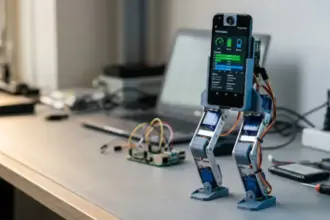

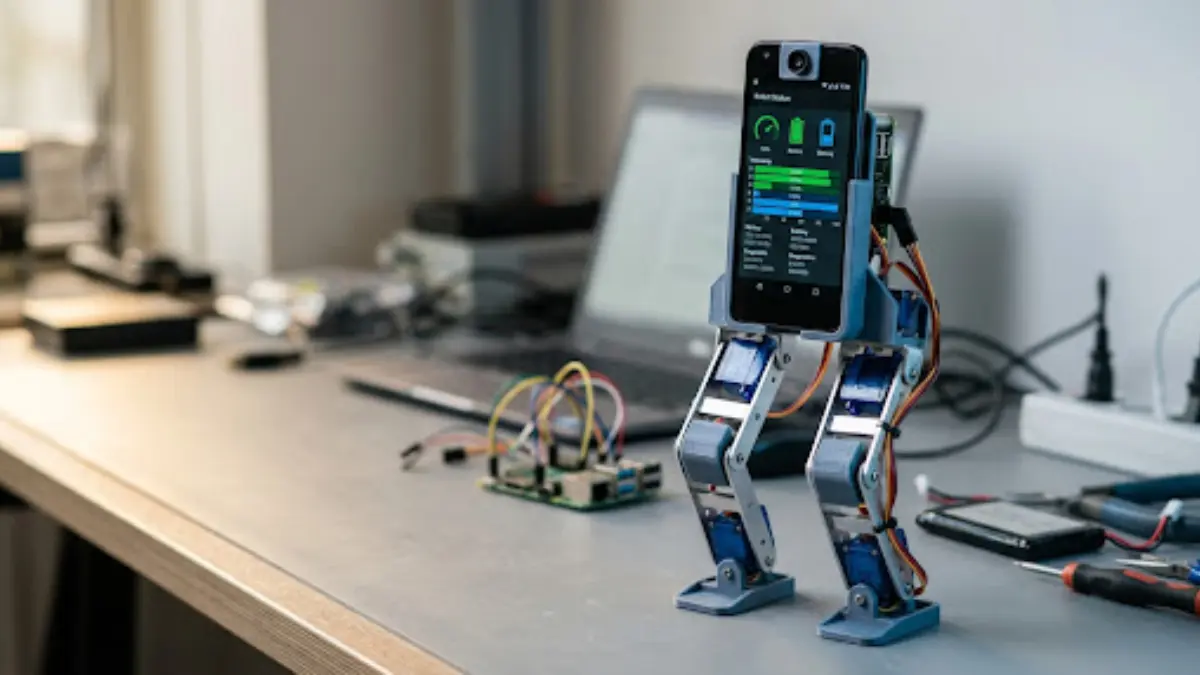

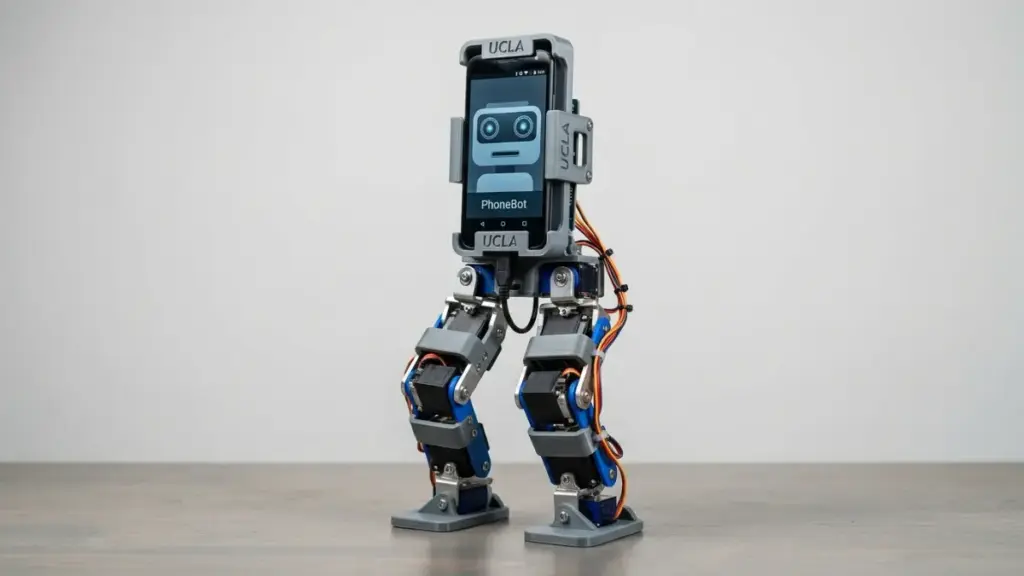
This UCLA robot uses a cheap old smartphone as its brain. It walks, follows people and gets back up after a fall, and nearly every headline gives the phone the credit.
- What this cheap old smartphone robot actually is
- Job 1: Learning to walk never happened on the phone
- Job 2: What the phone really does
- Job 3: The phone doesn’t move a single motor
- Job 4: The conversation lives on a laptop
- Where the money goes
- What a cheap old phone can’t do here
- So is the headline wrong?
- FAQ
The robot is called PhoneBot: a 48-centimeter walker described in an October 6 preprint from UCLA’s Robotics and Mechanisms Laboratory. Its body costs about $400 without the phone. The team tested four phones: a used 2017 Honor 9 and three new prepaid models that sell for roughly $50 to $90. One more detail the headlines skip: none of the four is both cheap and old. One is old, three are cheap.
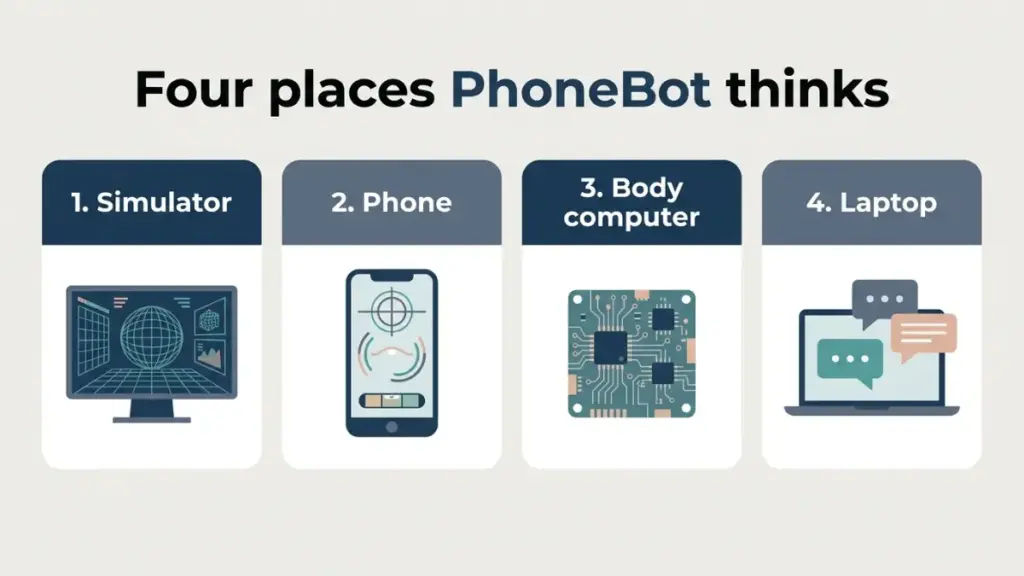
I read the paper, the parts list and the project page line by line. The phone is a real and useful part of this robot. But it is one of four places where the “thinking” happens, and the paper’s own measurements show its walking skill using only about 6% to 10% of the phone’s processor.
That is the catch, and it is not a flaw in the research. It is a gap between the headline and the paper.
What this cheap old smartphone robot actually is
PhoneBot is a research prototype: a small bipedal robot with an ordinary Android phone fixed where its torso would be. Here are the facts from the paper and the project page.
| Fact | Detail |
|---|---|
| Built by | UCLA’s Robotics and Mechanisms Laboratory (RoMeLa) |
| Status | arXiv preprint dated October 6, 2026, not yet peer-reviewed |
| Size | 48.3 cm tall, 1.8 kg including the phone and battery |
| Joints | 13 servo motors: six per leg plus one that twists the torso |
| Cost | About $400 for the body, phone not included |
| Phones tested | A used 2017 Honor 9, plus three prepaid Android phones at roughly $50 to $90 |
| Shown on the real robot | Walking, following a person with the camera, standing up from lying face-down |
| Missing | Arms, a head, and any training for uneven ground |
That is the whole machine. The interesting question is not what it can do, but where each of those abilities actually lives.
Job 1: Learning to walk never happened on the phone
The walking skill was learned inside a physics simulator, long before any phone touched the robot. The team trained a neural network with reinforcement learning, which works like a scorecard. The robot earns points for following a speed command, stepping with alternating feet and staying upright, and loses points for dragging a foot, slipping or overloading a motor.
The simulation even copies the real servos’ weakness. Each motor can only push with about 1.4 newton-metres of stall torque, so the virtual robot could not learn a move the real one could not perform.
How much practice did it take? The evaluated checkpoints had 500 million simulated steps behind them. At 0.02 seconds per step, that is about 10 million seconds, or roughly 116 days of walking. That is my arithmetic, and it assumes each step is one control step. Many virtual robots train in parallel, so it took far less real time.
There is a fun detail in the training. Early versions favored one leg, with the left foot leading and the right foot taking all the load. The fix was to also train on a mirrored copy of every step. In the paper’s simulation test, the left-right joint-angle error then fell from 0.254 to 0.003 radians. That result is from simulation, not from the physical robot.
Walking is also not the only skill. The team trained separate skills for standing up from lying down and for aiming the camera. The camera skill starts stepping only when a turn is too big for the torso to handle alone.
The phone learned none of this. It just carries the finished result.
Job 2: What the phone really does
The phone does two jobs that really matter, and it is fair to say so. It is the robot’s eyes and inner ear, and it runs the walking skill.
The phone is bolted to the robot’s trunk, so its motion sensor doubles as the body’s balance sensor and its rear camera is the robot’s camera. The app reads the motion sensor 200 times a second and runs the trained walking model 50 times a second. It also detects people and estimates their pose for following, and it builds a map of the room with Google’s ARCore. The touchscreen shows status and controls.
Those are the parts that normally need extra sensors, a vision computer and a tangle of wiring. Reusing a phone is the cost-saving idea here, and it holds up.
But the phone is not working hard. The paper measured how much of each phone’s processor every function uses:
| Phone | Released | Walking skill | Person detection | Room mapping |
|---|---|---|---|---|
| Honor 9 (used) | July 2017 | 9.8% | 17.9% | Did not run |
| moto g 2025 | January 2025 | 10.3% | 15.6% | 34.3% |
| Galaxy A16 5G | October 2024 | 7.1% | 17.6% | 28.3% |
| moto g 2024 | March 2024 | 6.3% | 16.7% | 25.2% |
Each figure is that function’s CPU use on its own, taken from the paper’s Table IX. The walking skill, the part that keeps the robot upright, takes between 6.3% and 10.3%. Only room mapping is heavy, at 25% to 34%.
Job 3: The phone doesn’t move a single motor
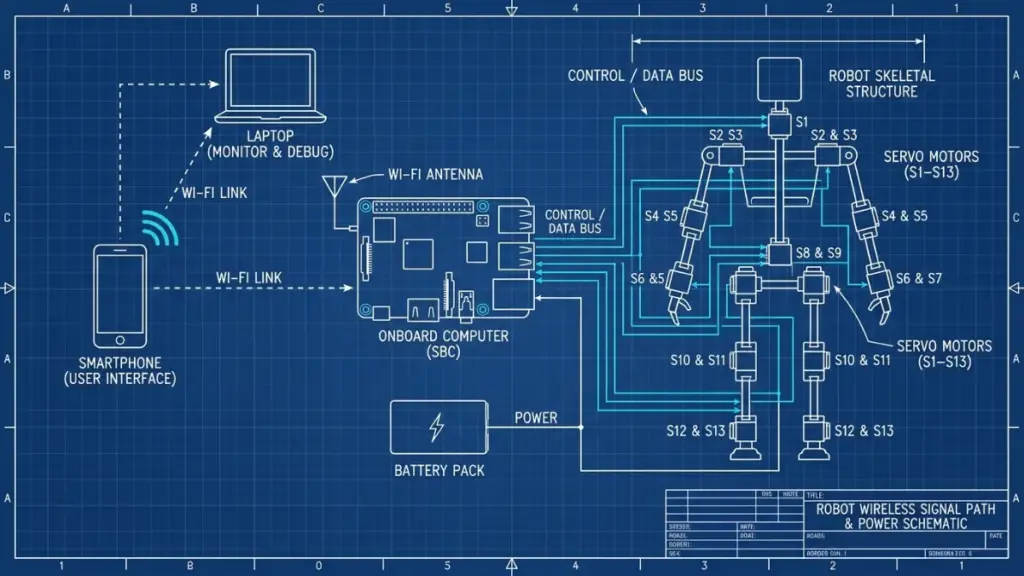
The phone is not wired to the robot at all. It sends target joint positions over Wi-Fi to a small single-board computer in the body. That computer passes them on to the 13 servos, and each servo then holds its position with its own built-in control loop. A battery pack in the body powers the motors and the small computer.
The authors say this was deliberate. With no cable between phone and body, any phone that can run the app can be swapped in.
It also shows what the phone replaced. It replaced the sensors and the vision computer. It did not replace the part that actually moves the legs, which still needs its own computer, battery and servos.
A walking robot whose legs are commanded over Wi-Fi also invites an obvious question: what happens when the connection stutters? I did not find that tested in the paper.
Job 4: The conversation lives on a laptop
When PhoneBot talks back, the intelligence is not in the phone. The phone records your voice and sends it over Wi-Fi to a laptop. On the laptop, a speech-recognition program turns the audio into text, and a large language model writes the reply. A text-to-speech program then voices it, and the phone plays the sound through its speaker.
The API key for the language model stays on the laptop, not in the phone’s app. The authors list running a suitable language model on the phone itself as future work, which would reduce the dependence on the laptop.
So today, the part of PhoneBot that sounds like a brain is not in the phone. A robot that can chat but needs a laptop within Wi-Fi range is a very different product from the headline’s picture of a phone-powered companion.
Where the money goes
The motors are the robot’s biggest expense, not the phone. The paper itself calls the servo the system’s primary expense, at $23.90 each.
| Item | Cost (USD) | How it is worked out |
|---|---|---|
| 13 servo motors | 310.70 | 13 × $23.90 |
| Everything else in the body | about 89 | $400 minus the servos (my subtraction) |
| One leg’s six servos | 143.40 | 6 × $23.90 |
| The phones tested | 50 to 90 | Prepaid listings, September 2026 |
Even the priciest prepaid phone tested costs less than the servos in a single leg. About three-quarters of the $400 is motors.
The “35 times cheaper” line in the coverage deserves a closer look too. The paper’s own comparison table lists five other small research humanoids from $3,500 to $13,800. Against the most expensive one, $13,800 divided by $400 is about 34.5. Against the cheapest, the $3,500 HighTorque Mini Pi, it is about 9. New Atlas also points out that those robots offer different capabilities, so it is not a like-for-like comparison.
Still, with a phone included, PhoneBot comes in under $500. That is genuinely cheap for a walking robot.

What a cheap old phone can’t do here
Read more: What kind of maintenance are you folks doing for your window AC units to ensure ac unit maintenance?
The limits are mostly in the paper itself, and they matter more than the headlines suggest.
- An old phone lost a feature. Room mapping did not run on the Honor 9, because Google services are unavailable on that device in the US. “Old phone” does not automatically mean “usable phone.”
- “Cheap” and “old” are different groups. The Honor 9 is an old flagship that launched at about $340 in China. The other three are new budget phones. The paper’s own wording is “old or low-cost.”
- Flat ground only. The walking skill was trained on flat terrain, and uneven ground is listed as future work.
- No arms, weak motors. The authors say the low-cost servos limit payload and dynamic motion.
- Slow by design. The walking skill was trained for speed commands up to 0.5 meters per second, about 1.8 km/h. A typical adult walks at roughly 5 km/h. That is a training range, not a measured top speed.
- Not very humanoid yet. Without arms or a head, it is better described as a bipedal robot with a phone for a torso.
- Still a preprint. The paper has not been through peer review.
None of this makes the work weak. It makes the “humanoid robot with a phone brain” picture in your head bigger than the real thing.
“A phone is the cheapest and easiest part of its brain, not the whole of it.”
So is the headline wrong?
Not wrong, but incomplete. The phone does two real jobs, seeing and running the walking skill, and those are exactly the jobs that used to need extra hardware. It does not learn the skills, move the motors or hold the conversation.
The idea itself is not new. OpenBot, from Intel researchers in 2020, already paired a phone with a roughly $50 wheeled body. What PhoneBot adds is legs, an open design, and a Wi-Fi link that lets different phone models take the same seat.
There is one more thing to know before getting excited about building one. The design files on the project site carry a non-commercial license, and commercial use needs separate permission from the rights holders. Hobbyists and classrooms can build it. A company cannot simply sell it.
What I would watch next: whether the team adds arms, whether it learns to walk on uneven ground, whether the language model moves onto the phone, and whether anyone outside UCLA builds one and reports the same results.
Until then, the most accurate way to describe PhoneBot is this: a phone is the cheapest and easiest part of its brain, not the whole of it.
FAQ
Is PhoneBot for sale? Not as a product. UCLA published it as an open research platform, and the project site’s design files use a non-commercial license that requires permission for commercial use.
Can any old phone run PhoneBot? Not necessarily. The team tested four Android phones, and room mapping did not run on the old Honor 9. The paper does not show that every Android phone works.
How much does PhoneBot cost? About $400 for the body, not including the phone. With a prepaid phone at roughly $50 to $90, the total stays under $500.
Is the smartphone really the robot’s brain? Partly. The phone sees through its camera and runs the walking skill, but the skill was learned in a simulator, a small computer in the body drives the motors, and a laptop handles speech and conversation.
Is PhoneBot a humanoid robot? The authors call it a compact humanoid platform. It has two legs and a phone for a torso but no arms or head, and it has only been trained to walk on flat ground.
Want the real story behind the next viral tech headline? At The Couch Insider, we read the papers so you don’t have to. Follow us for more breakdowns that separate the hype from what the research actually shows.