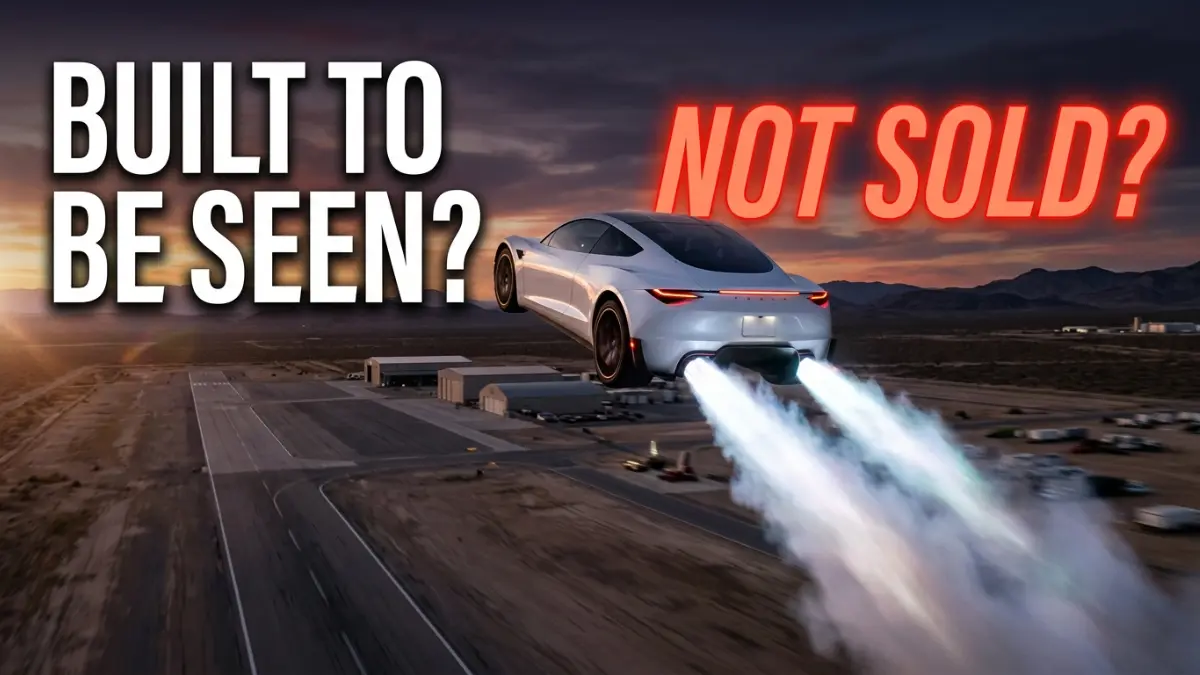

The Tesla Roadster thrusters made for a spectacular demo and, in my view, a poor product pitch.
- Car or prop? Settling the argument readers keep having
- What the Tesla Roadster thrusters can’t do
- Who is the customer?
- Why build Tesla Roadster thrusters at all?
- The track question: what would a pro driver do with it?
- Can you admire the engineering and distrust the promises?
- The Driveway Test
- The bottom line
- FAQ
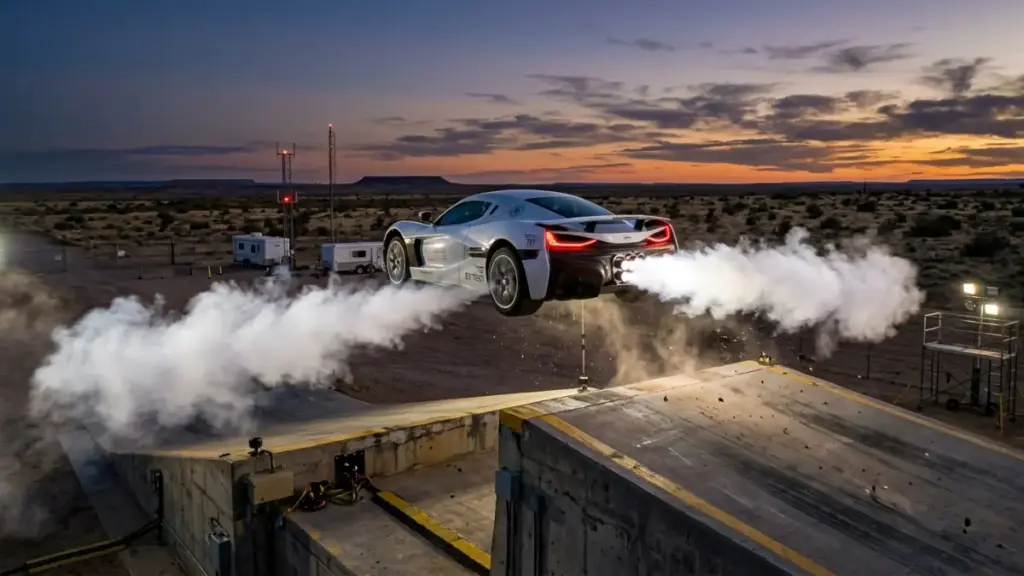
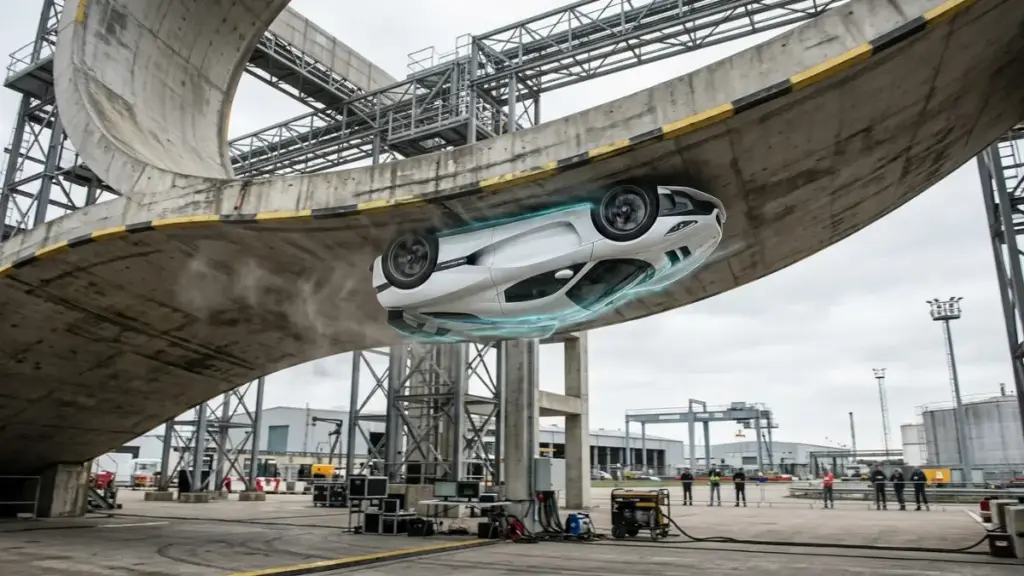
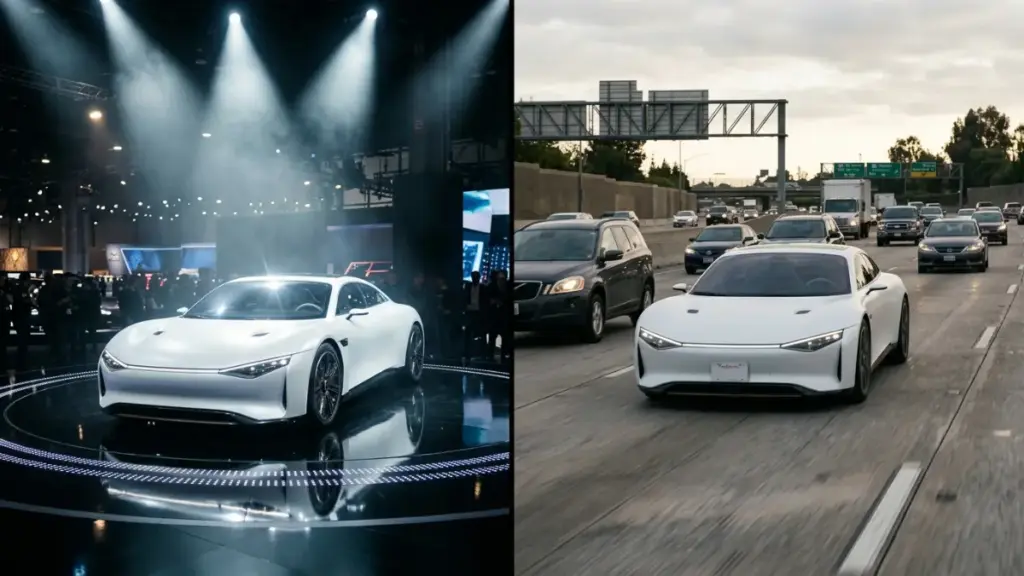
At a Texas event on Thursday, October 15, a white two-seater drove up a ramp that curled over until the car was upside down, left the end, rolled 180 degrees in mid-air and landed on its wheels. Later it used cold-gas thrusters to jump a truck while twisting through the air.
Tesla’s reservation page now lists three versions: Performance (50,000deposit),Thrust(250,000) and an invite-only, single-seat Rocket. Production is promised for 2028.
My argument is narrow. The Roadster is not vapor: Tesla’s engineers have shown a real interior and a real drivetrain. But the rocket layer behaves like an advertisement, a very expensive one, bolted to a car that still has to reach its first customer. The rest of this piece is built from the fights readers keep having about it, plus a few tests of my own.
Car or prop? Settling the argument readers keep having
The loudest claim in every comment section is that the Roadster is just a shell: look underneath, and it’s pressure vessels and pipes stuffed into a body to impress investors. That is half right.
In Tesla’s pre-reveal walkthrough video, the team opened the doors and showed a full cabin: a seat mounted low on the battery, a steer-by-wire yoke, heated seats, wireless charging and a dash display. They described a dual-motor rear-drive layout with roughly one megawatt of power. Whatever else it is, the Performance version is a car.
The “no room for people” crowd, though, is describing the thruster versions accurately. On the Thrust version, the 200-litre tank fills the trunk. On the Rocket, the second seat becomes a 400-litre gas tank and the car goes single-seat.
That is the pattern I keep coming back to: the more thruster hardware you add, the more the car trades the things that make a car useful (seats, luggage) for a few seconds of showmanship.
What the Tesla Roadster thrusters can’t do
The Tesla Roadster thrusters deliver about five seconds of thrust per fill, and a refill currently takes two to six hours. Those figures come from Tesla’s own engineers in the walkthrough video.
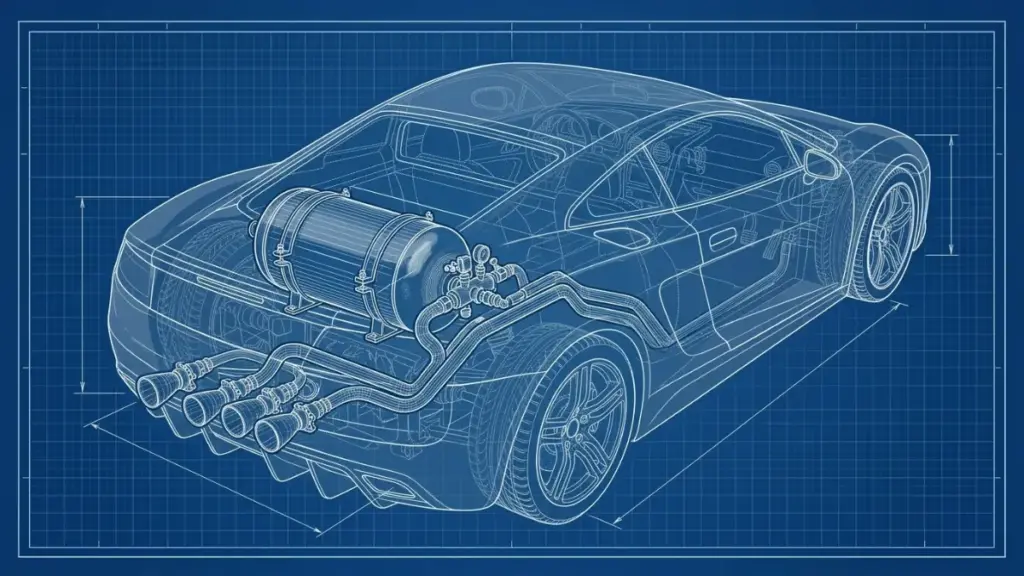
The Thrust version carries a 200-litre carbon-wrapped tank of cold nitrogen, rated to roughly 10,000 psi. There is no fuel burn, by design. One fill covers about a quarter-mile run, and the engineers were blunt that it is a one-time use per fill. Their stated hope is to cut refills to under half an hour; that is a goal, not a spec.
Read more: Why Was This Tesla Recall Involving Just 15 Vehicles Considered an Unprecedented Incident?
Then there is the road. The engineers said the system can’t be fired on public roads, because a piece of gravel at that pressure becomes a projectile. Tesla hasn’t explained how thruster maneuvers would be approved for the street, and pre-event reports said the demo car would be remote-operated and not street legal.
Here is the arithmetic I think matters most. Take five seconds of thrust and divide it by the time it takes to recharge:
| Refill time | Thrust per fill | Share of the refill cycle |
| 6 hours (upper current figure) | 5 s | 0.02% |
| 2 hours (lower current figure) | 5 s | 0.07% |
| 30 minutes (Tesla’s goal) | 5 s | 0.28% |
My arithmetic, from the engineers’ approximate figures. Even at Tesla’s best case, the thrusters are working for well under 1% of their own recharge cycle. A feature like that is a moment, not a capability.
Who is the customer?
The only buyer who needs the thrusters to work again and again is the one the hardware can’t serve. I see three possible buyers, and here is how each one fares.
The track-day owner. This person wants repeatable laps. A five-second, single-fill burst can’t be repeated lap after lap, and a refill takes hours. Whether any circuit or series would even allow a cold-gas thruster is a question Tesla hasn’t answered.
The collector. This is the most plausible buyer, and it explains why the Rocket is invite-only and the Thrust costs a $250,000 deposit. A collectible doesn’t have to be used. The thruster becomes a story the owner tells, not a tool.
The spectator and the investor. They never buy a car. They watch the clip. This is the audience the demo was built for, and the only one it served completely.
Why build Tesla Roadster thrusters at all?
Readers offer four explanations. I think the best answer combines two of them: a showpiece with real engineering underneath.
| Reader theory | What supports it | What weakens it |
| It’s a halo car | Tesla’s engineers say the first Roadster program fed the Plaid (motors, brakes) and call the thrusters the cherry on top | Halo tech usually trickles down; cold-gas thrusters have no obvious road-car descendant |
| It’s hype and deposit-gathering | Reservations opened in 2017 at $50,000 and $250,000, and Electrek counts at least eight delays; Tesla has reopened $50,000 deposits | Intent can’t be proven, only the effect |
| It’s a distraction from something else | Tesla’s focus is shifting to self-driving and robots, and Reuters said the reveal came days before Q3 results | Readers can’t agree on what it distracts from |
| It’s just great engineering | The suction system that held the car to an upside-down ramp is real hardware | A real feat can still serve a marketing goal |
One commenter made the sharpest point on theory two: thrusters would feel fine on a brand-new concept car, but they feel off on a Roadster that customers have waited on since 2017. I agree with that framing. The tech isn’t the problem; the order of events is.
A correction on a popular claim: several commenters say Tesla killed the Model S and X to build a flying hypercar. Reuters reported that Tesla stopped selling those models this year to make room for Optimus robot production, not for the Roadster.
The track question: what would a pro driver do with it?
A pro driver would be told no, and racing history shows why. One reader challenged the fans of this car to explain how a professional racer would use the system. It’s a fair challenge, and history answers it.
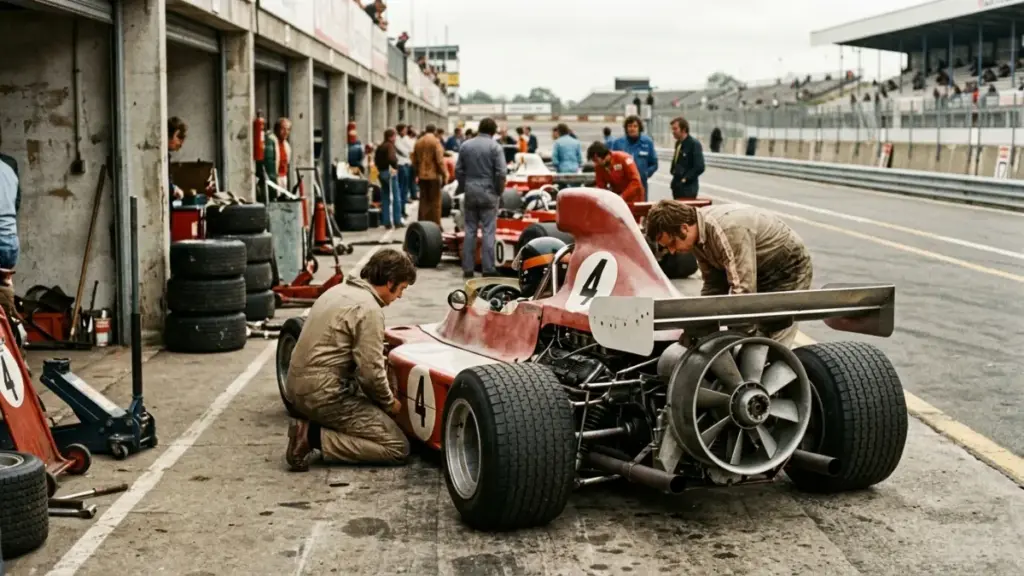
Fan-assisted downforce is old. Jim Hall’s Chaparral 2J ran with fans in 1970. In 1978 the Brabham BT46B won its only Formula 1 race, then was withdrawn, and movable aerodynamic aids were outlawed. Fan cars remain banned in top-level series.
Readers gave two reasons, and both hold up. First, a fan car depends on a mechanical system to keep load on the tires, so a failure, a bump or a piece of debris can remove grip suddenly. Second, Formula 1 cars already reach high cornering forces through conventional aerodynamics, so the fan wasn’t needed to make racing fast, only to make it unequal. Rivals at the time also complained about debris thrown behind the car.
Tesla’s suction skirts use the same idea to hold the car to a ramp. On a grid with rules, that’s banned. On a road car, it’s a party piece. So the pro driver’s answer is simple: not in a series with rules, and not for a car that spends its one shot in five seconds.
Can you admire the engineering and distrust the promises?
Yes, and I think that is the only honest position. This was the biggest fight in the comments, and it has two camps.
The first camp says a technology demo is a technology demo. Pushing limits is good for everyone, so celebrate it. One reader added that the credit belongs to hundreds of engineers, designers and technicians, not to one executive. The second camp says the demo can’t be separated from the company’s wider behavior and works mainly as a distraction.
I’d split it like this. The suction system, the brake-by-wire and the high-voltage architecture belong to the engineers, and they deserve credit. The dates, the deposits and the claimed numbers belong to management, and they deserve scrutiny.
Here is a test that avoids the personality argument entirely: would you accept this level of evidence from Ford or Porsche? A prototype that jumps a truck, a nine-year-old reservation list and a 2028 production date would not win a pass from most readers. It shouldn’t win one here either.
The Driveway Test
Only the Performance version passes the Driveway Test today. I ask three questions of any car: can a normal owner use it legally, can they repeat it, and can they actually buy it?
| Question | Performance | Thrust | Rocket |
| Usable on a public road? | Tesla says road-ready | Car yes; thrusters no, per Tesla’s engineers | Not stated by Tesla |
| Repeatable? | Yes, an electric drivetrain | One burst per fill, 2 to 6 hours to refill | Not stated |
| Can you reserve one? | $50,000 deposit | $250,000 deposit | Invite only |
| Independently verified? | Not yet | Not yet | Not yet |
All performance figures are Tesla’s own claims.
What would change my mind
- An independent 0 to 60 test on road-legal tires
- Crash certification for the production car
- First customer deliveries against the 2028 target
- A refill under 30 minutes, shown in public
- Tesla explaining how thruster use would be approved on roads
- Real specifications for the Rocket beyond “invite only”
The bottom line
The Tesla Roadster thrusters are real engineering, but they are a performance for an audience, not a feature for owners. The Performance car is the actual product, and until the first one reaches a driveway, 2028 is a target, not a promise. Admire the ramp trick. Then ask for the delivery date.
FAQ
Will the Tesla Roadster thrusters be street legal? Tesla’s engineers said the thrusters can’t be used on public roads, and Tesla hasn’t explained how they would be approved. The car itself is intended for road certification.
How much does the Tesla Roadster cost? Reservation deposits are $50,000 for the Performance version and $250,000 for the Thrust version. Final prices weren’t confirmed in the coverage reviewed here.
Can the Tesla Roadster fly? Tesla describes the single-seat Rocket as a flight system. The demo showed jumps and mid-air rotation, not sustained flight, and none of it has been independently verified.
When will the Tesla Roadster go into production? Tesla says 2028, after earlier targets of 2020, 2022, 2024 and 2025 to 2026.
Want more car and tech coverage that looks past the press release? Keep reading on Couch Insider.