



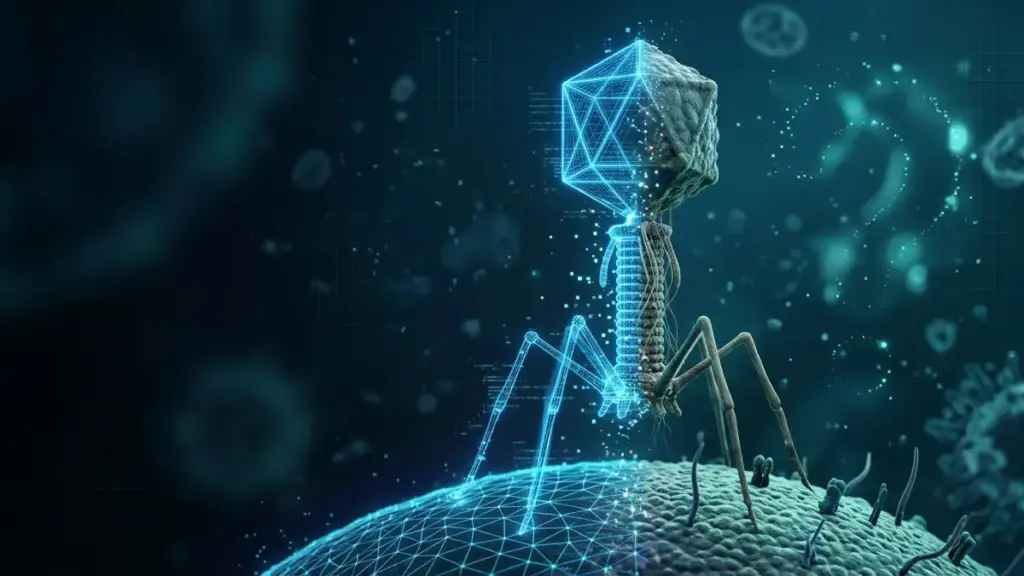
A San Francisco startup says it used AI to design viruses and gave them to a sick person. That part is An AI-designed virus has been given to a human patient for the first time. A San Francisco startup says it used AI to design the viruses and handed them to doctors treating a sick person.
On October 20, 2026, Radical Numerics published a technical report on its own website saying that phages designed by its AI model Omnii-1 were given to a patient with an antibiotic-resistant bacterial infection, under a physician-led compassionate-use pathway. The company calls it the world’s first clinical use of AI-designed phages.
I read the company’s report alongside the news coverage. Three gaps stand out in the AI-designed virus story:
- No outcome. The company says it cannot share the patient’s clinical course or results, citing privacy. So “treated” here means “administered,” not “cured.”
- No peer review. The report is a blog post on the company’s site, published the same day it launched the model it is selling.
- No independent verification. The company declined to name the patient or the doctors involved.
None of that makes the work fake. Phage therapy is real medicine, the antibiotic-resistance problem is real, and the lab work behind this has published roots. But an AI-designed virus milestone announced by the company that benefits from it, with the ending removed, deserves to be read carefully.
What was actually announced about the AI-designed virus
Two things went out on the same day: a new AI model called Omnii-1, and the claim about the patient. Here is what is confirmed and what is not.
| Question | Answer |
|---|---|
| Who | Radical Numerics, a San Francisco AI lab founded by members of the team behind the Evo and Evo 2 genome models |
| What | A cocktail containing phage variants designed by its Omnii-1 model, given to one patient |
| What a phage is | A virus that infects bacteria, not human cells |
| Pathway | An authorized, physician-led compassionate-use pathway, which lets seriously ill patients receive investigational treatments when nothing else works |
| Lab result | In lab testing, the cocktail eliminated the patient’s resistant bacteria in vitro, meaning in a dish |
| Patient outcome | Not disclosed |
| Peer review | None. Self-published technical report, October 20, 2026 |
| Patient and doctors | Not identified |
| Which bacterium | The company’s report says only “antibiotic-resistant bacterial infection.” The New York Times reported it was a stubborn E. coli infection |
| Regulator | The company refers to relevant government regulators. The NYT reported the FDA authorized it |
The lab numbers behind this AI-designed virus are more concrete than the clinical claim. For instance, among designed variants with 11 to 15 amino acid changes from the original, 69.9% produced working phages, compared with 4.8% of random controls. That is a real result about designing viruses that function. It says nothing about whether the patient got better.
Why anyone would build an AI-designed virus on purpose
Phage therapy is more than a century old, and it works on a simple idea: bacteria have natural predators, so use them. A phage lands on a bacterium, injects its genetic material, multiplies inside, and bursts the cell. Phages don’t infect human cells, and the World Health Organization describes phage therapy as generally considered safe.
The appeal now is antibiotic resistance. The company cites a projection of nearly 40 million deaths attributable to antibiotic resistance between 2025 and 2050.
The catch is matching. Each phage kills only certain bacterial strains, so doctors must find one that fits a specific patient’s infection, often by screening collections or hunting through soil and water samples. For someone critically ill, that search can take longer than they have.
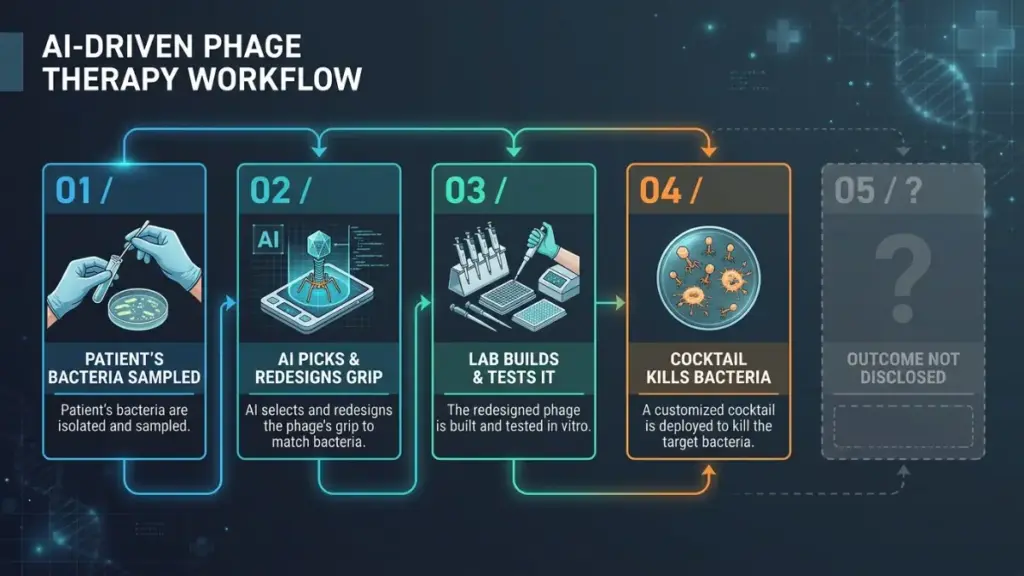
That matching problem is where AI fits:
- Pick a candidate. The model predicts which existing phages are likely to attack a given bacterial strain.
- Redesign the grip. Rather than inventing a whole genome, the team changes the part that determines what the phage latches onto. For the T7 phage, that means the tail fiber, the leg-like structure it uses to attach to E. coli.
- Rank the designs. The model scores which variants are most likely to work against that strain, so the lab tests the promising ones first.
- Build and test. The lab synthesizes the DNA, grows the phages, and measures whether they actually kill the target bacteria.
In this case, the company says the resulting AI-designed virus cocktail wiped out the patient’s resistant bacteria in a dish, and only then went to the doctors.
Four things the headlines get slightly wrong
I compared the coverage against the company’s own words. Four differences matter.
1. “AI created a virus from scratch” overstates what an AI-designed virus means here. Omnii-1 redesigned one part of an existing, well-studied phage called T7, first described in 1945. The company is explicit that generating new variants does not require designing an entirely new genome. Earlier work by the Evo team did generate complete phage genomes, but those were a much smaller virus, and that is not what reached this patient.
2. It wasn’t purely an AI-designed virus. The company’s wording is “the cocktail containing Omnii-1-designed phage variants.” A cocktail usually mixes several phages, and the report does not say the mixture contained only AI-designed ones.
3. “Treated” is doing a lot of work in every AI-designed virus headline. Compassionate use means a seriously ill patient received an investigational treatment, not that a trial measured whether it worked. The company itself notes that observations from a single patient cannot establish general safety or efficacy.
4. The bacterium is secondhand. The company’s report says only “antibiotic-resistant bacterial infection.” The E. coli detail comes from the NYT’s reporting, not the technical report. One outlet that read the report closely noted nothing in it points to a Pseudomonas aeruginosa infection either, despite that species appearing elsewhere in the document. The Register reached the same conclusion about how little was disclosed.
If this pattern feels familiar, it is the same gap we found between headline and paper in the UCLA robot that runs on a cheap old smartphone. None of these are lies by the company. Its report is reasonably careful. The distortion happens in the retelling, which is worth knowing if you are deciding how excited to be.
Read more: Next-Gen Microsoft Copilot App: The Evolution from AI Assistant to Autonomous Teammate
Why scientists are holding back applause
Harvard microbiologist Michael Baym gave the New York Times the reaction that sums it up: if it works, that’s incredible, but his impulse is to be skeptical.
That skepticism is about process, not about whether an AI-designed virus is possible. Three things explain it:
- The report is self-published. It went on the company’s website, not into a journal, and has not been peer-reviewed. Futurism noted the research reads more like a blog post than a study.
- The timing is commercial. The patient claim launched alongside Omnii-1, the product Radical Numerics is selling, and the same page invites hospitals and phage therapy centers to partner with the company.
- Privacy explains some of it, but not all. Protecting a patient’s identity is a legitimate reason to withhold details, and the company says even limited clinical information could identify them. Yet one outlet reported the company also cited the proprietary nature of a treatment it hopes to commercialize when declining to discuss the patient and doctors. Those are two different kinds of silence.
In medicine, the usual order is treat, follow up for months, then publish with outcomes. Phage therapy courses can run days or weeks, and doctors typically watch for recurrence for months afterward. Announcing at the moment of administration puts the headline a long way ahead of the evidence.
To be fair, the underlying science is not invented out of nowhere. The report builds on published work, including a Science paper this year on generative design of bacteriophages, and compares its predictions against two existing specialist methods.phages, and compares its predictions against two existing specialist methods.
The question the company raises about itself
The most interesting admission about the AI-designed virus is in Radical Numerics’ own announcement: the same advances that make it possible to design medicines can also be used to engineer pathogens that existing detection methods may miss. That is why the company says it is also building Omnii for biodefense, and it lists a separate defense contact address on its site.
Its research post adds that the company is committed to rigorous precautions for safe wet-lab work and says it will keep adapting its biosecurity, biosafety, containment, disposal and data-sharing measures as the models improve.
Two things are worth holding at once here. A phage is among the safer things to design, because it attacks bacteria rather than human cells, and this specific work modified one well-studied virus. But a model that can be steered to make a virus better at latching onto a chosen target is, in plain terms, a tool whose usefulness cuts both ways. The company is not hiding that. It is also the one deciding where the line sits, which is an argument for outside review rather than against the research. We have seen the same tension in AI emergency dispatch systems, where speed arrives before oversight does.
My verdict, and what would change it
Something genuinely new happened: an AI-designed virus went from a model’s output to a lab bench, past a regulator, and into a person. That sequence has not been publicly documented before, and the lab data behind it is specific enough to be checked later.
What has not happened is evidence that it helped anyone. Right now the honest summary is: a promising tool reached a patient, and the only people who know how it went are not saying.
Four things would move this from announcement to result:
- A peer-reviewed paper with the clinical course, even de-identified.
- An independent report from the treating team or hospital, rather than the company.
- More than one patient. A single case cannot show safety or efficacy, as the company itself notes.
- Outside replication by a lab with no stake in Omnii-1.
Until then, an AI-designed virus reaching a patient is a milestone in what AI can design, not yet a milestone in what it can cure.
FAQ
Did the AI-designed virus cure the patient? Unknown. The company says the phages were administered but will not disclose the outcome.
Is this AI-designed virus dangerous to humans? Phages infect bacteria, not human cells, and the WHO describes phage therapy as generally considered safe. This one was engineered to target bacteria.
Was this approved by the FDA? The company says an authorized, physician-led compassionate-use pathway was used and refers to relevant government regulators. The NYT reported the FDA authorized the trial. Compassionate use is not the same as approval for general use.
Can I get this treatment? No. It is investigational and not approved for broader use. The company is recruiting hospitals and phage therapy centers as partners. For how AI is reaching ordinary patients today, see our piece on Apple Health’s move into on-demand blood work.
Was the AI-designed virus built from scratch? No. It redesigned part of T7, an existing E. coli phage studied since the 1940s.
Who is Radical Numerics? A San Francisco AI lab founded by members of the team behind the Evo genome models, now selling a model called Omnii-1 for biology.
Is phage therapy new? No, it is over a century old. What is new is using AI to design a custom phage quickly instead of hunting for one.
This article is general information, not medical advice.
AI is moving into medicine faster than the evidence is. The Couch Insider reads the original reports, not just the press releases. Follow us for the follow-up when Radical Numerics publishes real clinical data.