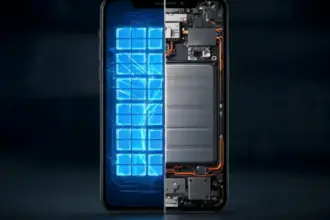



The debate surrounding hybrid vehicles often revolves around promises of massive MPG (miles per gallon) figures and environmental salvation. However, for a professional driver logging up to 45,000 miles per year, such marketing claims are insufficient. The core question remains: How can a machine carrying the massive weight of both a traditional internal combustion engine and an electric battery system optimize energy efficiency without ever needing a plug?
The truth is, hybrids do not create energy from thin air; they are masterpieces of ‘waste management engineering.’ Yet, beneath the flashy exterior of power-split algorithms and Atkinson-cycle engines lie harsh physical limitations, confusing computational algorithms, and maintenance risks that could wipe out all your fuel savings.
Mastering the technical nuances of How Hybrid Sedans Save Fuel Without Plugging In is essential for any high-mileage owner. This article will comprehensively dissect the energy-generation mechanism of hybrid vehicles, revealing the complex logic of How Hybrid Sedans Save Fuel Without Plugging In, while exposing the operational truths that only those who truly live on the highway dare to face.
Thermodynamic Mechanism: The Atkinson Cycle Principle
To answer the central question of how the system saves fuel, we must start at the combustion chamber. Most traditional gasoline vehicles use the Otto cycle. Meanwhile, modern hybrids (such as the Toyota Prius, Honda Accord Hybrid, or Hyundai Elantra Hybrid) use the Atkinson-cycle engine.
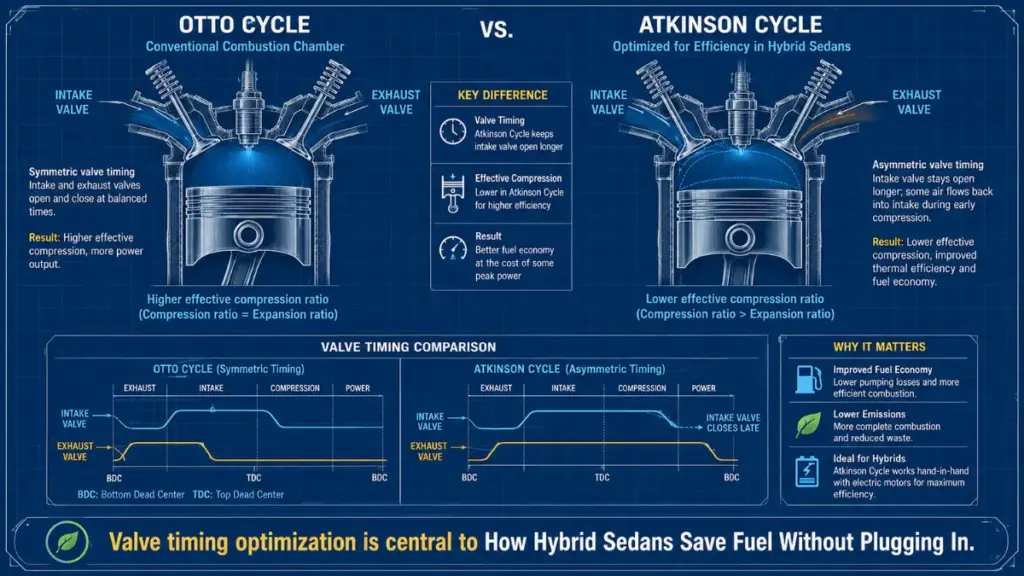
Mechanically, the Atkinson cycle intentionally keeps the intake valve open longer than usual during the compression stroke. A portion of the air-fuel mixture is pushed back into the intake manifold. This reduces the effective compression ratio compared to the expansion ratio, allowing the engine to extract more “work” from every drop of burning fuel. The thermal efficiency of an Atkinson engine can reach 40–41%, an incredible figure compared to the 30–35% of a conventional Otto engine. It is precisely this thermodynamic advantage that serves as the cornerstone for How Hybrid Sedans Save Fuel Without Plugging In, as the system focuses on maximizing thermal extraction from every combustion event. By prioritizing expansion over compression, this cycle defines the internal efficiency of How Hybrid Sedans Save Fuel Without Plugging In while minimizing the fuel-burning requirements of the vehicle.
However, the law of conservation of energy dictates that nothing is perfect. Pushing the air-fuel mixture back causes the Atkinson engine to lose a significant amount of low-end torque. This is why a non-hybrid car using an Atkinson engine would be extremely sluggish when taking off. To compensate for this fatal weakness, an electric motor is introduced. The electric motor provides 100% torque from zero RPM, filling the power gap of the internal combustion engine. This is the first step in creating a perfectly self-compensating system.
Power-Split Device: The Energy Coordination Heart
Many mistakenly believe hybrids use conventional CVT gearboxes (using belts and pulleys). In reality, Toyota’s transmission system (e-CVT) uses an extremely complex set of planetary gears called a Power-Split Device. This system connects three main components: the internal combustion engine, the motor generator MG1, and the drive motor MG2. Understanding this gear arrangement is fundamental to grasping How Hybrid Sedans Save Fuel Without Plugging In, as it eliminates the friction losses typical of belt-driven systems. By orchestrating these components through gear ratios rather than physical friction, the drivetrain facilitates the seamless energy flow that defines How Hybrid Sedans Save Fuel Without Plugging In.
“It’s more complicated than you think. Back when conventional vehicles were 4-speed automatics, it was simpler; now, with planetary gearsets and electric motor-generators, the engine output is constantly being modulated to match the vehicle’s load in ways a traditional transmission never could.”
Jade
- Internal Combustion Engine (ICE).
- Motor Generator 1 (MG1).
- Motor Generator 2 (MG2).
There are no physical clutches or belts here. The sun gear, planet gears, and ring gear rotate independently but are closely linked. When you accelerate lightly in the city, MG2 draws electricity from the battery to turn the wheels (the gas engine is completely off). When you accelerate hard, the gas engine starts, transmitting force through the planetary gears; part of the force goes directly to the wheels, and part of the force spins MG1 to generate current. This elegant, clutchless design is exactly how Hybrid Sedans Save Fuel Without Plugging In, as it eliminates the friction losses that plague traditional transmissions and maximizes energy recovery during every drive.
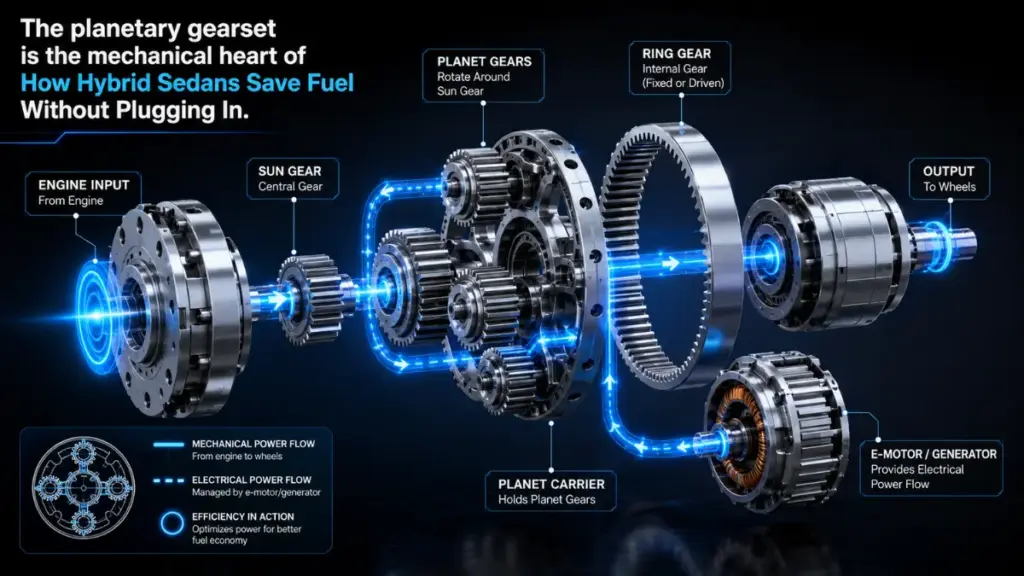
The current from MG1 is immediately transmitted through MG2 to boost propulsion or sent to the Inverter to charge the battery. The computer calculates thousands of times per second to decide this power distribution ratio, ensuring the gas engine always stays in its “Sweet Spot,” never needing to “roar” unnecessarily.
Regenerative Braking
The biggest reason hybrids excel in stop-and-go urban environments is their ability to recover kinetic energy. In a traditional gas car, when you step on the brake, the pads press against the rotors, turning all the kinetic energy of a 1.5-ton metal block into useless heat dissipated into the air. By contrast, this regenerative capability is one of the primary mechanisms behind how Hybrid Sedans Save Fuel Without Plugging In, as it efficiently converts momentum into stored electrical energy rather than letting it go to waste.
With a hybrid, your brake pedal is an electronic switch. When you brake lightly, the mechanical pads have not yet touched the discs. Instead, the computer reverses the polarity of the electric motor (MG2). MG2 stops acting as a drive motor and becomes a massive generator. The car’s kinetic energy travels from the wheels back to MG2, spinning the coils within the magnetic field, creating electromagnetic resistance (slowing the car down) and generating current that charges the high-voltage battery. This regenerative process is a vital component of How Hybrid Sedans Save Fuel Without Plugging In, as it recovers energy that would otherwise be lost as heat. By recycling momentum back into the battery, this system illustrates How Hybrid Sedans Save Fuel Without Plugging In through simple, yet highly effective, electromagnetic physics.
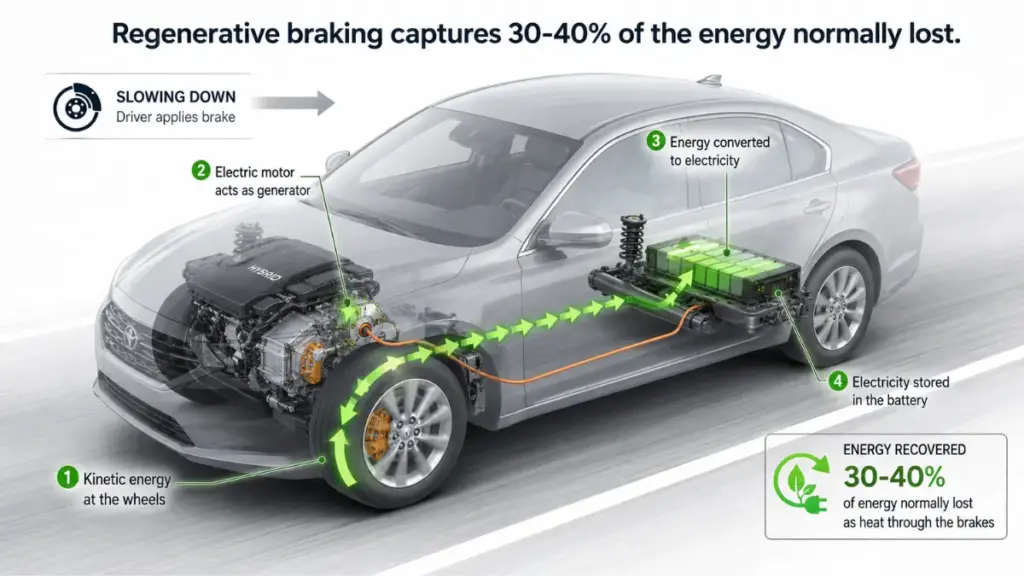
This is how the vehicle recovers up to 30–40% of the energy that would otherwise be wasted. In city environments, where you constantly accelerate to 25mph and brake at red lights, the “Energy Out -> Energy In” cycle happens continuously. You are using the car’s own momentum to charge its battery.
Load-Leveling and BSFC
Have you ever wondered why, when cruising on a flat road, the gas engine sometimes roars louder than necessary, and the dashboard indicates the battery is charging? This is “Load-Leveling,” an incredibly clever mechanism often misunderstood by users. It is a defining feature in How Hybrid Sedans Save Fuel Without Plugging In, as it intentionally forces the engine into its most efficient operation zone. By shifting the engine load, the system ensures that fuel is burned at the highest possible thermal efficiency, proving that the secret to How Hybrid Sedans Save Fuel Without Plugging In is not always about running less, but running smarter.
Every internal combustion engine has its own Brake Specific Fuel Consumption (BSFC) map. BSFC indicates the amount of fuel required to produce 1 horsepower in 1 hour. If the car needs 15 hp to maintain 45mph, but at that 15 hp level, the gas engine operates very inefficiently (burning more fuel per hp produced).
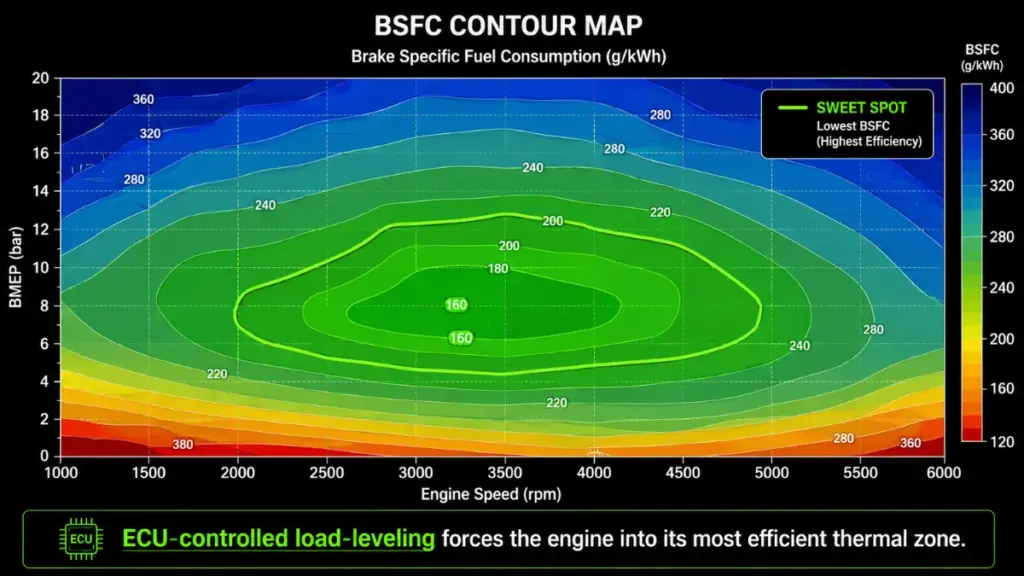
Instead of running at an inefficient 15 hp load, the ECU (central controller) will command the engine to run at a 35 hp load (where it achieves the best BSFC efficiency, burning fuel most thoroughly). 15 hp is used to turn the wheels, while the remaining 20 hp of excess force is sent to the generator (MG1) to charge the battery.
In this way, the car isn’t charging the battery for “free.” It uses gas to charge the battery, but it does so in a state where the conversion ratio of thermal energy to mechanical energy is highest. This stored electrical energy is then used to pull the car at low speeds, shutting off the gas engine entirely. This sophisticated compensatory calculation is a definitive example of how Hybrid Sedans Save Fuel Without Plugging In, proving that intelligent energy management is far more effective than traditional fuel consumption methods.
The Auxiliary Revolution: Why Hybrid Auto Stop-Start Doesn’t Damage the Engine
In many forums, owners of pure gas cars often complain about Auto Stop-Start systems due to concerns about starter failure and engine wear due to oil pressure drops. But in a hybrid, this system operates in a completely different physical space, fundamentally changing the perspective on How Hybrid Sedans Save Fuel Without Plugging In. Unlike traditional vehicles, hybrids use electrified auxiliary components and high-voltage motors to eliminate mechanical stress during restarts. This sophisticated integration ensures that the frequent engine cycling does not compromise the vehicle, showcasing exactly How Hybrid Sedans Save Fuel Without Plugging In while maintaining long-term engine reliability.
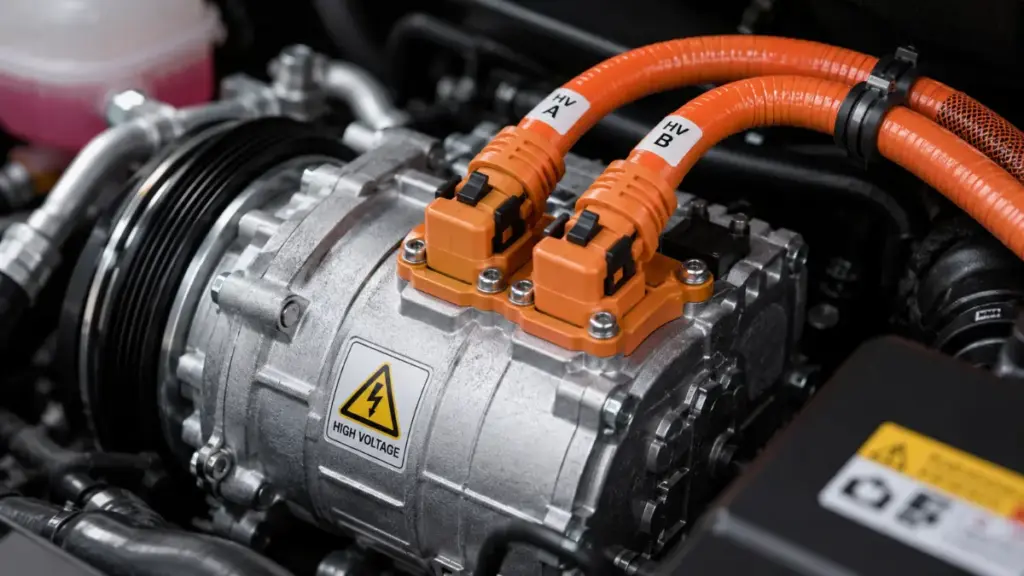
First, hybrids do not have a traditional 12V starter. They use the massive high-voltage electric motor (MG1) to spin the engine. MG1 can pull the gas engine from 0 to 1,000 RPM in less than a quarter of a second, so quickly and smoothly that you don’t feel the vibration. Second, every auxiliary load on a hybrid is electrified. The AC compressor, water pump, and most importantly, the oil pump, all run on electricity from the high-voltage battery.
When stopped at a red light, the gas engine shuts down, but the air conditioning remains cold because it runs on the battery. More importantly, the electric oil pump continuously maintains lubrication pressure inside the engine block. When the computer decides to restart, MG1 spins the engine a few times to create momentum and evenly distribute the oil film before the spark plugs actually fire and the injectors pump fuel. Therefore, wear and tear during Start-Stop in a hybrid is almost zero, which serves as another critical operational advantage of how Hybrid Sedans Save Fuel Without Plugging In while ensuring engine longevity.
The Harsh Reality on the Highway: Aerodynamics vs. Mass
You now understand the divine fuel-saving mechanism. Now it is time to face the operational reality that automotive journalists rarely mention: the naked truth at 80mph (130km/h).
The laws of aerodynamics dictate that air resistance increases with the square of velocity. When you drive at 70–80mph, 80% of the engine’s energy goes just to split the air. At these speeds, the advantages of a hybrid disappear.
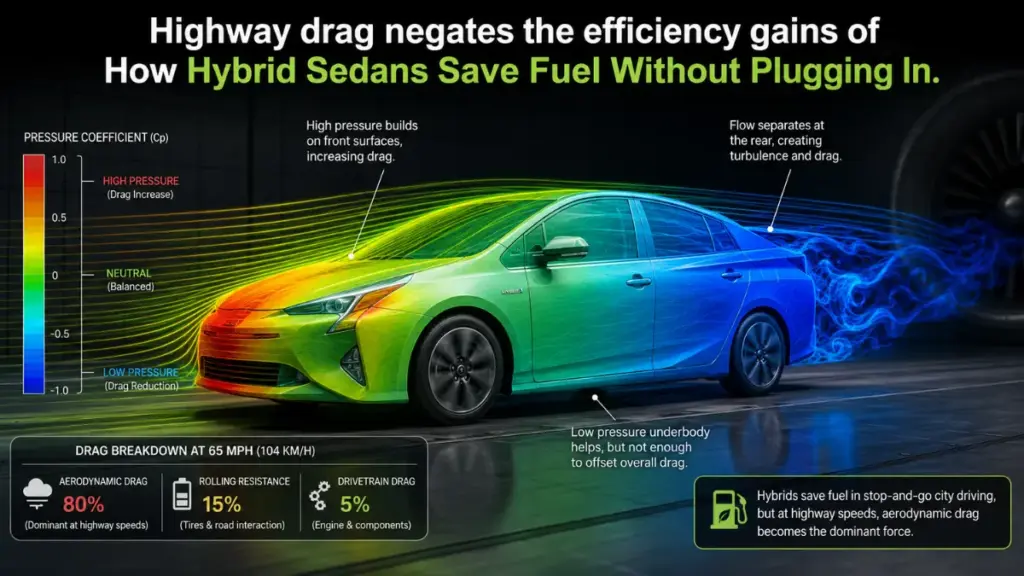
First, you are not stepping on the brake during steady-state cruising, meaning there is no Regenerative Braking. Second, the Atkinson engine is inherently weak in raw power, and it now has to carry the extra weight of the battery pack and motor (which can be 200–300 lbs heavier than a similar gas car), plus face massive air resistance. These physical constraints highlight the operational limits of how Hybrid Sedans Save Fuel Without Plugging In, as highway drag significantly diminishes the efficiency advantages typically seen in urban driving conditions.
Small-displacement hybrids often have to operate at very high RPMs to maintain 80mph, causing MPG to drop drastically, sometimes consuming more gas than a diesel or a large-displacement gas engine (like a Volvo 2.4L or an old Honda Accord 2.0L). A hybrid is born to be the king of the city, but it can become “starving” on high-speed interstate journeys. This performance gap highlights the specific operational boundaries of How Hybrid Sedans Save Fuel Without Plugging In, as aerodynamic drag begins to negate the efficiency benefits of the electric drivetrain. It serves as a stark reminder that the principles behind How Hybrid Sedans Save Fuel Without Plugging In are optimized for variable urban speeds rather than the constant, high-load demands of long-distance, high-speed cruising.
The “Bricking” Trap: When Technical Limits Betray You
This is the most terrifying technical vulnerability that many long-distance owners have experienced. A hybrid’s Battery Management System (BMS) is designed to keep battery capacity between 30–80% to extend cell life. However, it lacks a critical failsafe.

Take a real-world case from the community: The fuel pump malfunctions, making the engine unable to start. The car still tries to use the electric motor to move or crank the engine. Instead of recognizing the fuel error and immediately disconnecting the drivetrain to protect the high-voltage battery, the algorithm allows the battery to drain to 0% in an attempt to complete the operation command. This algorithmic oversight exposes a dangerous flaw in the logic of How Hybrid Sedans Save Fuel Without Plugging In, where the pursuit of mobility can inadvertently trigger system self-destruction. It serves as a grim warning that the software governing How Hybrid Sedans Save Fuel Without Plugging In can sometimes fail to protect the very components that make the hybrid system functional in the first place.
When a hybrid’s NiMH or Lithium-ion battery pack is discharged below the critical voltage threshold (Deep discharge), it suffers permanent chemical damage. This process is called “Bricking.” You cannot recharge it. And the worst part? The manufacturer will claim that “running out of gas/fuel pump failure is user error” to refuse warranty coverage for a $4,000 battery pack. A tiny flaw in the code can wipe out all the money you saved on gas over five years, serving as a harsh reminder of the hidden risks inherent in the complex engineering behind how Hybrid Sedans Save Fuel Without Plugging In.
The Invisible Assassin: Soy-Based Wire Insulation
Starting a decade ago, under pressure from environmental regulations, most automakers replaced petroleum-based wire insulation with soy-based bio-plastic materials. To Mother Nature, this is progress. To hybrid users, this is a financial disaster. This shift in material science has introduced an unexpected threat to the systems that manage How Hybrid Sedans Save Fuel Without Plugging In, as the engine bay becomes an attractive feeding ground for rodents. When these critical signal cables are compromised, the complex communication network required for How Hybrid Sedans Save Fuel Without Plugging In is disrupted, often leading to costly repairs that fall outside the scope of standard manufacturer warranties.
A hybrid engine bay is warm and filled with thick orange high-voltage cables and countless complex sensors. To rodents (mice, squirrels), soy-based wire insulation smells and tastes exactly like food. When these critical connections are compromised, the entire infrastructure that allows Hybrid Sedans Save Fuel Without Plugging In is jeopardized, often leading to electrical faults that render the vehicle inoperable.
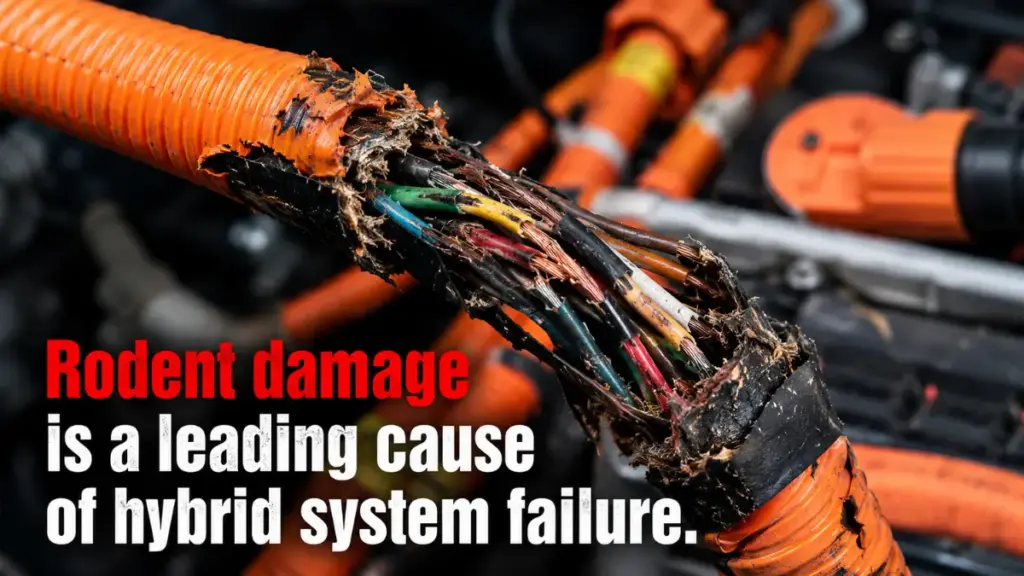
When an inverter system data cable is chewed through, the car will report a series of errors and refuse to start. This is not a mechanical failure. However, when you tow the car to the dealership, the standard answer is always: “Damage due to external factors, not covered by the manufacturer’s warranty.” You have to pay out of pocket to replace the entire wiring harness at an exorbitant price, not to mention the labor to disassemble the entire engine bay.
Pro tip: Never accept the dealer’s conclusion. For drivers doing over 45,000 miles/year, the car is a livelihood tool. Persistently call the Corporate hotline. Argue that materials attracting animals are a “manufacturing material defect,” not normal wear and tear. Many users have been reimbursed by Corporate after refusing to give up.
The Deception of Numbers: Range Algorithm (Distance To Empty)
There is a topic that constantly explodes on automotive forums: ‘Why do I go downhill, the gas engine is off, the battery is charging, but the Range on the dashboard keeps dropping?’ The truth is, your car is ‘lying’ to you. This confusion stems from a misunderstanding of the predictive algorithms used to calculate range, which is just one of the many digital complexities behind how Hybrid Sedans Save Fuel Without Plugging In and how they manage energy forecasting in real-time.
In old gas cars, the Range gauge is simply the result of Fuel Level x Average Consumption. However, hybrids use a “Blended Algorithm.” The computer continuously evaluates the potential energy of both the gas tank and the electricity in the battery.
The problem is, this algorithm relies too heavily on historical operational data. When you move from city streets to the highway, the computer notices that efficiency is gradually decreasing, and it will immediately “shave off” the projected km of Range for safety, regardless of the fact that you might be coasting downhill or in short-term EV mode. The amount of electricity (kWh) in a non-plug-in hybrid is too small compared to the thermal capacity of the gas tank, so it cannot act as a direct, linear addition to the Range. This discrepancy often confuses drivers trying to understand How Hybrid Sedans Save Fuel Without Plugging In, as the digital readout fails to reflect the real-time energy recovery occurring under the hood. Ultimately, these fluctuating range estimates are a byproduct of the software’s attempt to forecast efficiency, rather than a definitive measurement of How Hybrid Sedans Save Fuel Without Plugging In.
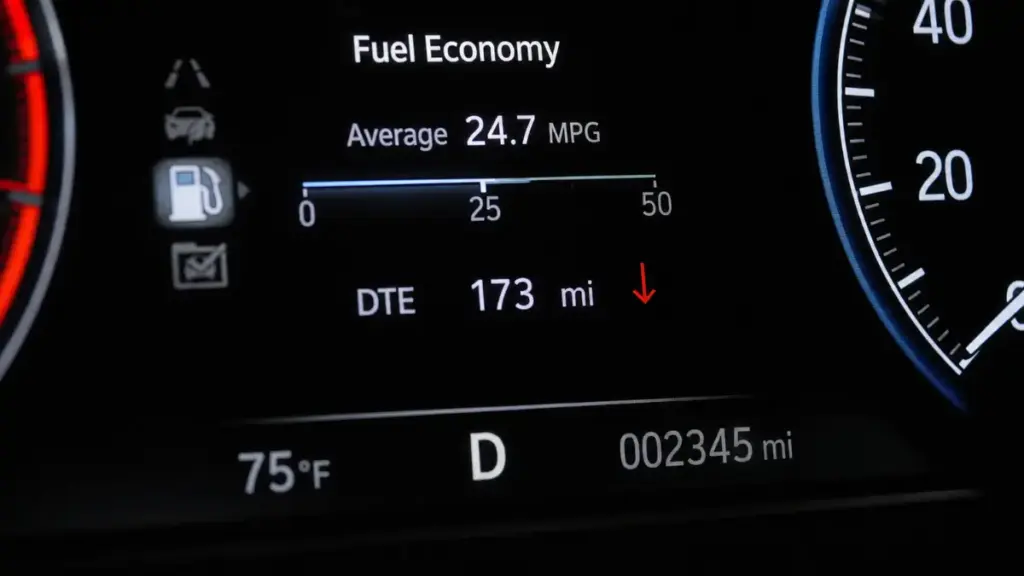
Obsessively tracking Range only leads to “Range Anxiety.” The secret of long-distance drivers is: Just look at the physical gas gauge and ignore the computer’s DTE algorithm.
The Illusion Called “EV Mode”
Most modern hybrids have an “EV Mode” button that allows for pure electric driving. Many people abuse this button when driving in alleys or parking lots, hoping for maximum savings. This is a fatal energy mistake. Relying on manual intervention often disrupts the sophisticated balance that dictates How Hybrid Sedans Save Fuel Without Plugging In, as the system is designed to manage energy more efficiently than a human driver ever could. When you force the car into a mode it isn’t ready for, you create a chain reaction of inefficient energy use, undermining the fundamental principles of How Hybrid Sedans Save Fuel Without Plugging In and potentially forcing the engine into a wasteful recovery cycle.
The battery of a traditional hybrid is only about 1–1.5 kWh (1/50th of a true electric vehicle). When you force the car into EV Mode, you drain the battery extremely quickly. The BMS hates a low State of Charge (SOC). As soon as you turn off EV Mode or exceed the allowed speed (usually 25mph), the computer falls into a “Panic Charge” state.
The gas engine will have to roar at very high RPMs, burning a massive amount of gas to jam electricity back into the battery as quickly as possible to bring the SOC back to a safe 50%. This forced charging process has very high thermal energy losses. The final result? The amount of gas you burn to “recharge” is more than the amount of gas you saved by pressing the EV button. Remember: A hybrid is most efficient when you let the computer decide everything.
The “Unicorn” Strategy for High-Mileage Drivers
For those driving 180 miles/day, the maintenance philosophy is completely different from the average user.
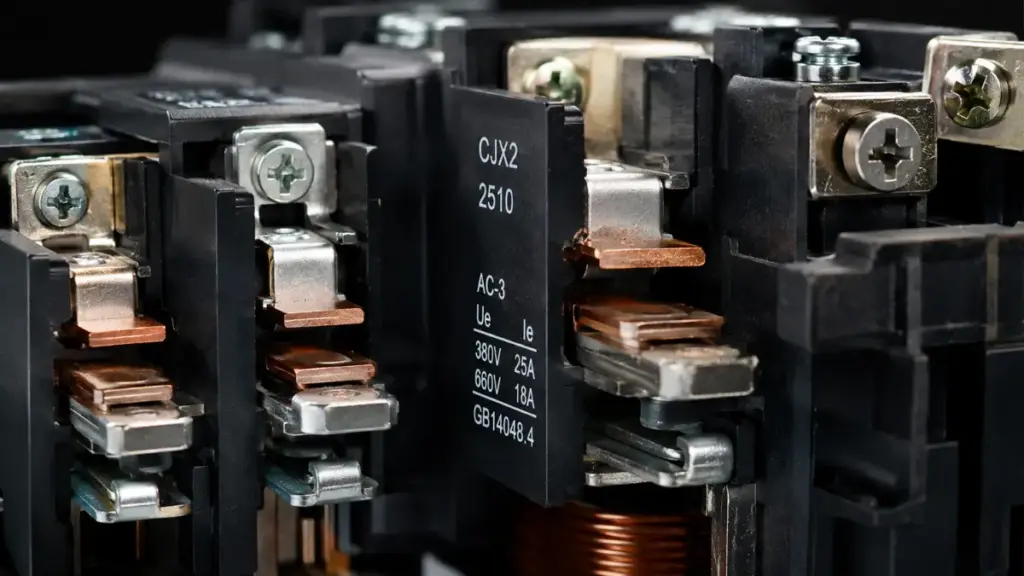
Use It or Lose It A strange but absolutely real thing in the hybrid world: Cars that hit 300,000 miles are often those that drive long distances continuously (like ride-sharing taxis or cross-state salespeople). Conversely, hybrids that sit idle suffer from electronic failures constantly. The cause lies in the high-voltage relays and electronic contacts. High-intensity current flowing through the inverters generates heat. If the car operates continuously, the cooling system works smoothly, and the contacts don’t oxidize. When the car sits idle for long periods, moisture attacks open circuits and corrodes contact points. This highlights why consistent usage is a crucial factor in How Hybrid Sedans Save Fuel Without Plugging In, as the system relies on active electrical flow to prevent degradation. Effectively, keeping the hybrid active is a form of preventive maintenance that sustains the core mechanics of How Hybrid Sedans Save Fuel Without Plugging In over hundreds of thousands of miles.
Preemptive Maintenance The Owner’s Manual is written to optimize the estimated Cost of Ownership for users driving 12,000 miles/year to remain competitive in sales. If you drive 45,000 miles/year, following the manual is suicidal.
- Inverter Coolant Loop: Hybrids have two separate cooling systems (one for the gas engine, one for the inverter/electric motor). The Inverter is the brain processing 600V current; it gets extremely hot. Inverter coolant typically loses its dielectric and thermal conductivity properties after 40,000 miles. If the inverter overheats, the entire Hybrid system collapses. Change the inverter coolant twice as often as recommended.
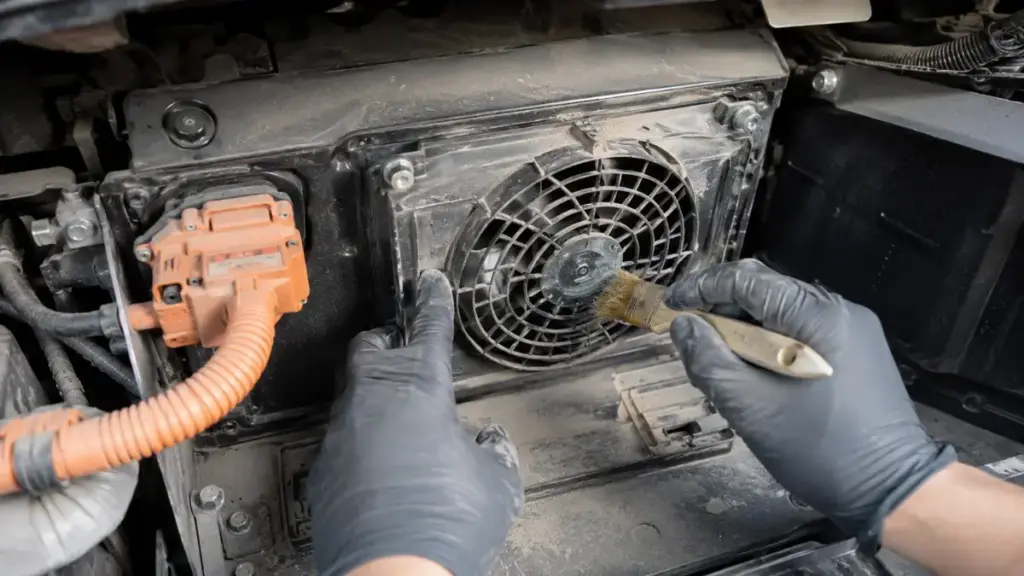
- Battery Cooling Fan: Located under the rear seat, this fan draws air from the cabin to blow into the battery pack. If you have pets or drive in dusty conditions, this fan will be clogged after 2 years. When airflow decreases, the battery heats up, internal resistance increases, the BMS throttles discharge current, and your car will feel noticeably weaker, leading to a disastrous drop in MPG. Removing the plastic cover and cleaning the fan with compressed air is the cheapest maintenance tip, but it saves a $4,000 battery pack. Maintaining this airflow is a critical, yet overlooked, aspect of How Hybrid Sedans Save Fuel Without Plugging In, as optimal battery temperature is essential for efficient energy discharge. Without proper cooling, the system cannot function at its peak, directly compromising the efficiency that defines How Hybrid Sedans Save Fuel Without Plugging In.
“The ‘set it and forget it’ mentality is what kills hybrid components. If you drive a hybrid like a taxi—consistently and daily—the relays and inverters stay within their healthy thermal operating window. It’s the ‘garage queens’ that sit for weeks that end up with corroded contacts and sensor failures.”
Jade
Conclusion: Don’t See It as a Car; See It as a “Mobile Server”
A non-plug-in hybrid sedan is a miraculous machine of engineering and thermodynamics. It thoroughly exploits the physical waste of the internal combustion engine, compensates with the magnetic fields of electricity, and recycles kinetic energy through regenerative braking.
However, this sophistication comes with a price in terms of risk management. To survive past the 200,000-mile mark without going “bankrupt” from electronic repair bills, you must abandon mindless driving habits.
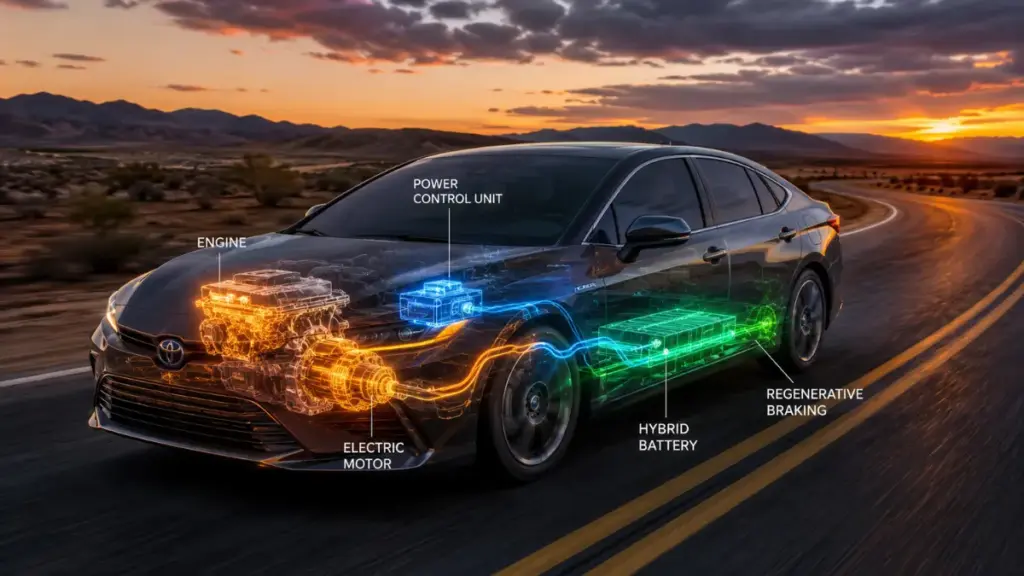
You must understand the blind spots of the Atkinson cycle on the highway, the deception of the Range calculation algorithm, and always stay one step ahead in protecting the cooling system as well as the signal wiring. Ultimately, your long-term financial success depends on how well you adapt your driving style to the operational realities of How Hybrid Sedans Save Fuel Without Plugging In. By treating the vehicle as a high-tech asset rather than a simple commuter, you ensure that the complex systems governing How Hybrid Sedans Save Fuel Without Plugging In continue to reward you with efficiency for years to come.
In short, a hybrid is a sharp financial tool to beat fuel costs. But like all sharp tools, if you do not understand its core operating mechanism, you are the one who will get cut.