



SpaceX has vaporized 260 satellites in six months, but it is not just “routine maintenance.” Behind the PR facade, scientists and tech critics are sounding the alarm on a brewing atmospheric crisis. As the SpaceX Starlink satellite deorbit frequency accelerates, the environmental cost of our global internet ambition is coming into sharp focus. While the company markets these disposals as a cleanup measure, the long-term impact of dumping thousands of tons of metal into our upper atmosphere remains a volatile, under-researched, and potentially catastrophic gamble for our ozone layer.
- The truth about SpaceX Starlink satellite deorbit operations
- Environmental impacts of the Starlink satellite deorbit process
- Debunking the orbital data center myth
- Regulatory challenges and the role of the FCC
- Economic and technological evolution of Starlink
- Expert perspectives on the future of low Earth orbit
- The dark side of orbital management
- Is there a better way forward?
- The accountability gap in space operations
- Conclusion: The hidden price of global internet
The truth about SpaceX Starlink satellite deorbit operations
The SpaceX Starlink satellite deorbit strategy is frequently presented by the company as a paragon of responsible space management. By design, these units are meant to incinerate completely upon atmospheric reentry, leaving no space junk behind. However, this narrative ignores the fundamental physics of what happens when advanced, chip-dense hardware meets the harsh reality of Earth’s atmosphere.
When we look at the raw data, the scale is staggering. Between late 2025 and mid-2026, hundreds of units have been brought down. The SpaceX Starlink satellite deorbit process isn’t just a cleanup—it is a continuous, industrial-scale cycle of manufacturing, launching, and incinerating. Proponents argue this is a necessary sacrifice to prevent Kessler Syndrome, the catastrophic collision scenario that could render low Earth orbit unusable for generations. Yet, critics argue that this “disposable tech” model is fundamentally flawed. We are essentially treating the Earth’s atmosphere as an infinite trash bin, simply moving the pollution from a visible orbital plane to an invisible, chemical layer above us.
Environmental impacts of the Starlink satellite deorbit process
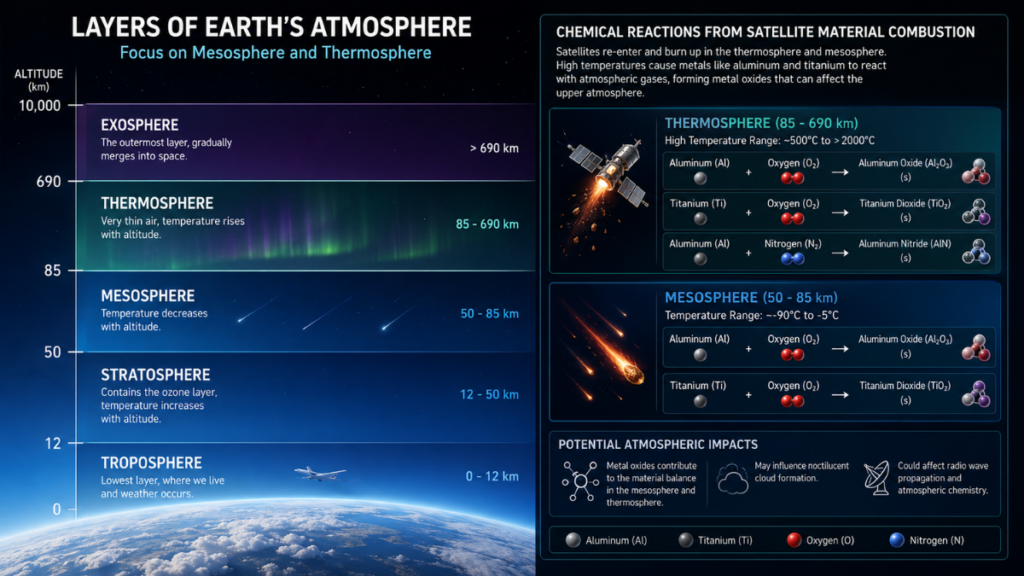
The core issue with the SpaceX Starlink satellite deorbit cycle lies in the chemistry of the incineration. When a multi-hundred-pound piece of hardware enters the atmosphere at hypersonic speeds, it doesn’t just “disappear.” It undergoes thermal degradation, turning solid structures into vaporized metal particles. The primary concern is the release of alumina, or aluminum oxide, into the mesosphere. These particles do not simply vanish; they remain suspended, acting as catalysts for heterogeneous chemical reactions.
Recent studies suggest that these metallic particles can accelerate the depletion of the ozone layer by providing a surface for reactions that would not otherwise occur. While some industry apologists point to the daily influx of natural meteoritic dust to minimize the impact, this comparison is intellectually dishonest. Meteoritic dust and the high-density aluminum oxides from a controlled SpaceX Starlink satellite deorbit are not chemically identical. The latter provides a concentrated, artificial, and localized injection of reactive metals directly into the regions where ozone recovery is most delicate.

Debunking the orbital data center myth
In recent headlines, we have seen the emergence of “orbital data centers.” The idea of moving our computation needs to space sounds like a futuristic dream, but a closer look reveals that the SpaceX Starlink satellite deorbit plans and data center concepts are being conflated to generate hype. An orbital data center would require massive solar arrays for power and, more crucially, immense radiators to dissipate heat. In the vacuum of space, radiation is the only way to cool hardware. Without massive cooling surfaces, compute-heavy satellites would melt themselves instantly.
The “orbital data center” label is arguably a marketing sleight of hand. By tagging these projects with the buzzword of the year, firms can boost investor confidence while avoiding the cold reality of physics. For every benefit, there is a logistical nightmare. Latency is limited by the speed of light, making space-based servers less efficient for real-time applications than terrestrial equivalents. To claim that SpaceX Starlink satellite deorbit programs are merely the first step toward a space-based computational revolution is to ignore the stark financial and engineering walls that these projects hit at every turn.

Regulatory challenges and the role of the FCC
The governance of the SpaceX Starlink satellite deorbit process is currently a wild west of corporate lobbying. The FCC has been under fire for its attempt to exclude space-based operations from the National Environmental Policy Act (NEPA). By labeling these as “extraterritorial activities,” the commission is effectively creating a legal vacuum. If the activities occur outside US jurisdiction, the logic goes, then environmental regulations do not apply. This is a terrifying precedent.
It essentially allows for “space crimes” to go unmonitored. Critics argue that the SpaceX Starlink satellite deorbit strategy should be subject to the same stringent environmental impact assessments as any terrestrial industrial facility. If we are pouring thousands of tons of metal into the atmosphere, the public deserves to know the exact chemical composition of those emissions and the long-term projections for ozone health. The lack of transparency in these regulatory exemptions is not just a bureaucratic oversight; it is a systemic failure to protect the only atmosphere we have.

Economic and technological evolution of Starlink
Economically, the SpaceX Starlink satellite deorbit model is a high-stakes gamble on launch costs. The business case relies on the assumption that launch prices will continue to plummet, making it cheaper to burn old hardware and launch new, more efficient versions than to service or upgrade them in orbit. However, this assumes that the environmental cost will remain at zero—a calculation that is increasingly looking like a massive underestimation.
More Read

Investors worship the “genius” of the leadership, but at the ground level, the engineering remains fragile. We are witnessing the normalization of disposable infrastructure. If the SpaceX Starlink satellite deorbit cycle is the future, we must ask if this is a sustainable direction for human progress. We are spending an absurd amount of production effort—mining rare earth elements, fabricating advanced chips, and assembling complex systems—only to set them on fire a few years later. This is a massive misallocation of resources that creates value for a private company while offloading the environmental cost to the global commons.

Expert perspectives on the future of low Earth orbit
The scientific community is deeply divided. On one hand, the SpaceX Starlink satellite deorbit program is technically successful at preventing orbital debris accumulation. As one engineer noted, the alternative is Kessler Syndrome, where orbital lanes become so crowded that collision events chain-react, effectively locking humanity to the surface of the planet. No one wants that. However, the solution being offered may be just as toxic as the problem it solves.
“The challenge of space expansion is not just the launch, but the responsible end-of-life cycle that preserves our atmosphere for the next millennium.”
Luna
Experts in atmospheric chemistry are calling for global lidar monitoring networks to measure the accumulation of metallic vapor in the mesosphere. Currently, we are flying blind. We are relying on the assumption that the SpaceX Starlink satellite deorbit process is safe because we haven’t seen an immediate catastrophe. But atmospheric chemistry is notoriously sensitive to small changes. By the time we have conclusive evidence of ozone layer damage, the damage may already be irreversible.

The dark side of orbital management
Critics often point out that the SpaceX Starlink satellite deorbit strategy is “ragebait” for anti-Musk segments of the internet. But even if we strip away the personality cult, the math remains stubborn. We are moving toward a future with hundreds of thousands of satellites. The current incineration rates, while manageable today, will look fundamentally different when scaled by a factor of fifty. Can the atmosphere handle a hundred times the current metal flux?
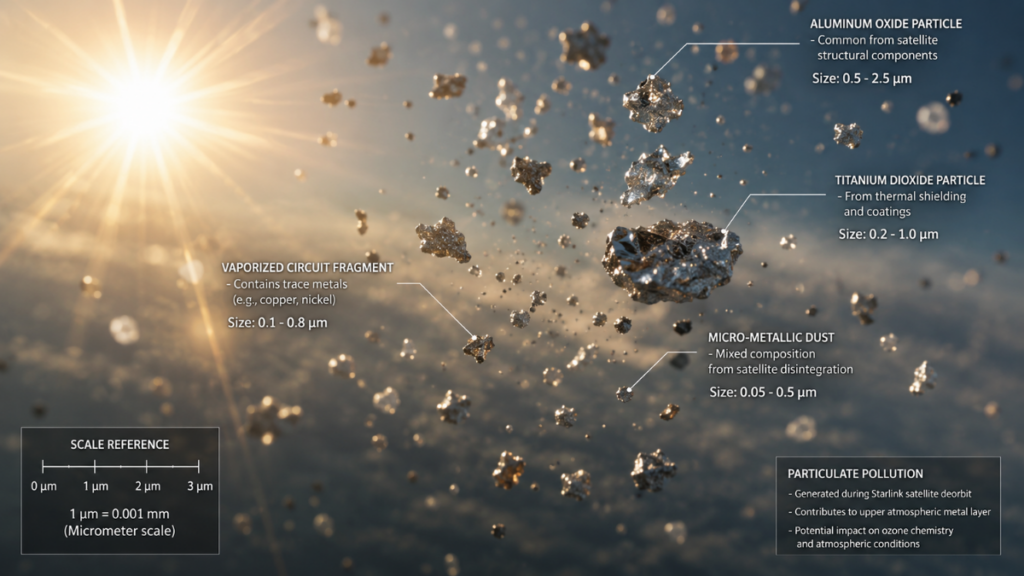
Furthermore, the SpaceX Starlink satellite deorbit process doesn’t just put metal in the air; it creates a massive amount of micro-particulates. There is no comprehensive research on the long-term respiratory or systemic health effects of breathing or living beneath an atmosphere laden with a constant drizzle of sub-microscopic metallic ash. While it may seem “far away,” these particles eventually settle and integrate into the global climate cycle.
Is there a better way forward?
If the SpaceX Starlink satellite deorbit strategy is the best we can do, we are in trouble. But is it? Some have suggested that we move away from massive LEO constellations toward more robust, long-lived GEO (geostationary) infrastructure, or invest in better in-orbit recycling technologies. However, these are expensive. The current market rewards speed and low initial costs, and burning up satellites is the quickest way to achieve that balance sheet success.
The fundamental issue is that space is being treated as a proprietary industrial asset. Whether it is a government-backed agency or a private billionaire-led firm, the SpaceX Starlink satellite deorbit program demonstrates that profit-driven space exploration does not always align with the public’s interest in a preserved environment. Without independent oversight, we are left at the mercy of corporate PR, which will always claim their path is the only sustainable one.

The accountability gap in space operations
Ultimately, the SpaceX Starlink satellite deorbit discussion highlights an accountability gap. Who owns the sky? If the atmosphere is degraded, how do we assign blame? The lack of international treaties that effectively govern “atmospheric pollution from space” means that companies can continue to scale these operations without answering to a global authority.
As we look toward 2030, the number of units expected to undergo the SpaceX Starlink satellite deorbit process will reach into the thousands per year. If we do not act now to implement independent, multi-national monitoring of atmospheric chemistry, we will simply have to deal with the consequences after they become glaringly obvious—and by then, the “orbital data center” or “high-speed internet” of the future will have cost us a cleaner, safer planet.

Conclusion: The hidden price of global internet
The SpaceX Starlink satellite deorbit model is a triumph of corporate logistics and a potential disaster for environmental preservation. It perfectly encapsulates our current era: prioritizing speed and connectivity at the cost of long-term stability. The technology is impressive, the network is transformative, but the price tag—the true environmental price tag—is being hidden from the public record.
We must stop accepting PR slogans as science. Whether you are an investor, a tech enthusiast, or a concerned citizen, it is time to ask hard questions about the SpaceX Starlink satellite deorbit program. Is this truly the most sustainable way to bring the world online? Or are we just building a faster, shinier, and more connected world while setting the foundation of our atmosphere on fire?
LEAVE A COMMENT TO GET FREE ADVICE FROM OUR EXPERTS, OR FOLLOW THE COUCH INSIDER WEBSITE TO STAY UPDATED WITH THE LATEST KNOWLEDGE.