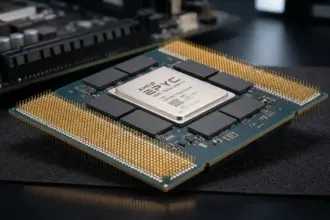



In an era dominated by relentless credential harvesting and sophisticated identity theft, relying on a dedicated password manager has become a fundamental cornerstone of digital hygiene. Security professionals globally advise individuals and enterprise organizations to abandon predictable, recycled credentials in favor of complex, randomly generated strings stored inside encrypted vaults. However, an unsettling reality exists beneath the interface of daily convenience: even an industry-leading password manager can present critical attack vectors when unlocked on an active endpoint. While marketing materials frequently emphasize robust end-to-end encryption algorithms, volatile system memory remains a uniquely vulnerable staging ground where plain text secrets temporarily reside. Understanding these architectural compromises is crucial for evaluating how an unlocked password manager handles master key derivation, dynamic memory allocation, and post-session buffer cleanup.

The Illusion of Zero Knowledge in Modern Password Manager Security
The marketing foundation supporting almost every commercial password manager relies on the principle of zero-knowledge architecture. This security framework dictates that service providers, cloud infrastructure hosts, and rogue network eavesdroppers cannot access stored credentials because vault encryption occurs locally before data transmission. When an encrypted vault syncs across remote servers, it exists strictly as an opaque, unreadable blob encrypted with high-grade algorithms such as AES-256 or ChaCha20. Consequently, even if a server database suffers a catastrophic breach, zero-knowledge design guarantees that without the user’s local master key, the stolen vault remains cryptographically inaccessible.
However, zero-knowledge architecture strictly governs data at rest and data in transit; it does not fully insulate data in use. The moment a user inputs their master key into a password manager, the application must derive the master encryption key—typically via memory-hard functions like Argon2id or PBKDF2—and execute local decryption. During this operational phase, decrypted strings must exist within local volatile memory so the application can auto-fill browser credentials, display account details, or copy authorization tokens. Once credentials enter random access memory, the absolute boundary promised by zero-knowledge design encounters the harsh realities of host operating system mechanics.
When an active session forces a password manager to store decrypted material inside user-space RAM, the security burden shifts entirely from cryptographic algorithms to operating system process isolation. If local memory buffers are not meticulously zeroed out or protected against unauthorized process inspection, the theoretical protections of zero-knowledge architecture dissolve. Security researchers and forensic analysts frequently observe that while remote cloud vaults remain virtually unbreakable, the local system memory hosting an active password manager often exposes cleartext secrets to local process scraping tools.
“Zero-knowledge design guarantees that remote cloud databases cannot read your encrypted vault, but it offers zero immunity against local process inspection when an active application decrypts those secrets directly inside volatile host RAM.”
Luna
How Decryption Works When Your Password Manager Vault Is Active
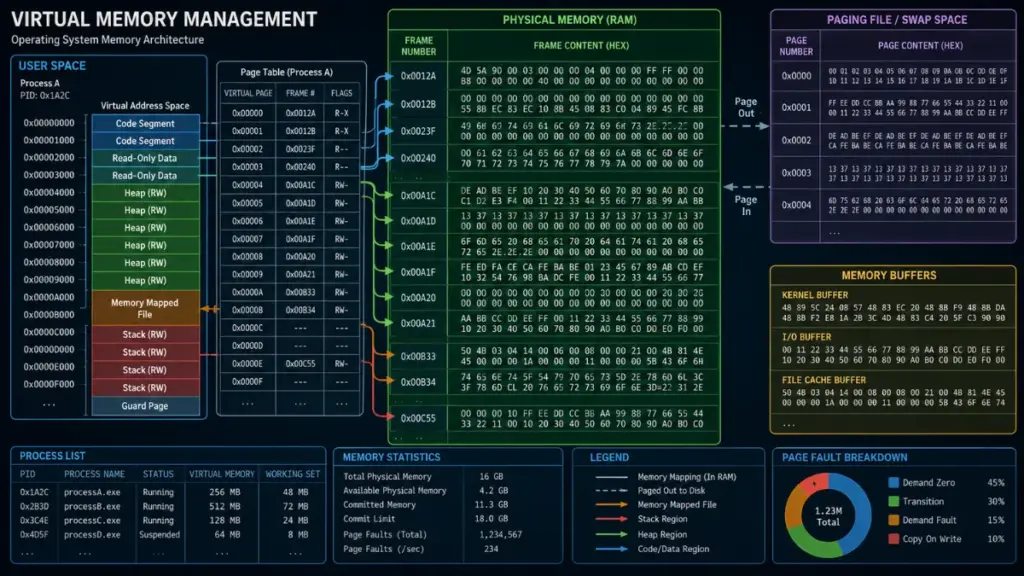
To evaluate why volatile memory presents such a persistent attack surface, one must trace the precise operational sequence that occurs during vault authentication. When a user launches a password manager and enters their primary passphrase, the application passes this input through a key derivation function designed to resist brute-force cracking. The resulting cryptographic key is then loaded into dynamic memory buffers, where it acts as the primary key to unlock local sqlite databases or JSON structures containing site logins, private notes, and two-factor authentication seeds.
Once decryption completes, the application retains various data structures within host RAM to provide a smooth user experience. Without holding these keys or decrypted items in memory, the application would force users to re-enter their master passphrase every time they requested a login auto-fill. Consequently, an active password manager keeps plain text credentials, session tokens, or the derived master key continuously accessible within its assigned memory process space as long as the vault status remains unlocked.
Readmore: Passkey Google on Android: Why Default Security Fails Power Users
This design tradeoff creates an inevitable window of vulnerability. Because modern desktop operating systems manage memory through complex paging systems, garbage collectors, and dynamic string allocations, plain text credentials often replicate across multiple RAM addresses during routine execution. Unless software engineers write low-level memory management code that explicitly locks memory pages and overwrites discarded buffers with zero-bytes, remnants of the decrypted vault linger inside volatile RAM long after specific credentials are no longer actively displayed.

Why RAM Retention Vulnerabilities Negate Zero Knowledge Claims
RAM retention vulnerabilities occur when sensitive cryptographic keys or decrypted credentials remain present in physical system memory after they should have been securely erased. In high-level programming frameworks such as C#, JavaScript/Electron, or Java—which are widely used to construct modern multi-platform software—memory management is controlled by automated garbage collection routines rather than manual memory management. When a modern password manager written in these frameworks processes a master password, string objects are routinely created, copied, and moved across memory spaces without immediate deletion.
Automated garbage collection prioritizes application performance and memory availability over security sanitization. As a result, when a string variable containing a master password is marked for deletion by an application, the underlying framework simply unlinks the reference while leaving the raw binary data sitting inside unallocated RAM blocks until another application overwrites that specific memory segment. During this lingering window, any utility capable of reading process memory can locate and extract plain text secrets.
- Garbage collection frameworks fail to scrub memory addresses immediately after variable dereferencing.
- Immutable string objects force the operating system to create duplicate memory instances whenever text is modified.
- System swap files and hibernation dumps copy volatile RAM contents directly onto persistent disk storage.
When volatile RAM retains plain text credentials across idle states, the protection promised by zero-knowledge encryption becomes fundamentally compromised. The encryption algorithm protecting the vault file on disk remains mathematically sound, yet the actual secret key sits exposed inside unencrypted physical memory, completely accessible to any local process running with sufficient privileges.

Critical RAM Storage Flaws Exposing Your Password Manager Master Password
Deep forensic examinations of popular software architectures reveal that memory management flaws are rarely isolated anomalies; rather, they stem from structural design choices made during application development. When a password manager handles authentication, it must process inputs from graphical user interface (GUI) text boxes, pass those inputs to cryptographic libraries, and maintain active session state variables. At each layer of this application stack, improper string handling can leak the master password into unmanaged memory pools.
Furthermore, desktop applications built on web-wrapper frameworks like Electron inherently inherit the complex memory behavior of modern browser engines. Chromium-based frameworks allocate vast amounts of memory for rendering, JavaScript execution, and DOM management, making strict memory sanitization exceptionally difficult to enforce. Even applications compiled natively in C or C++ frequently suffer from memory retention issues if developers rely on standard library string functions rather than specialized, non-swappable secure memory structures.
Unencrypted String Remnants Left by Popular Password Manager Apps
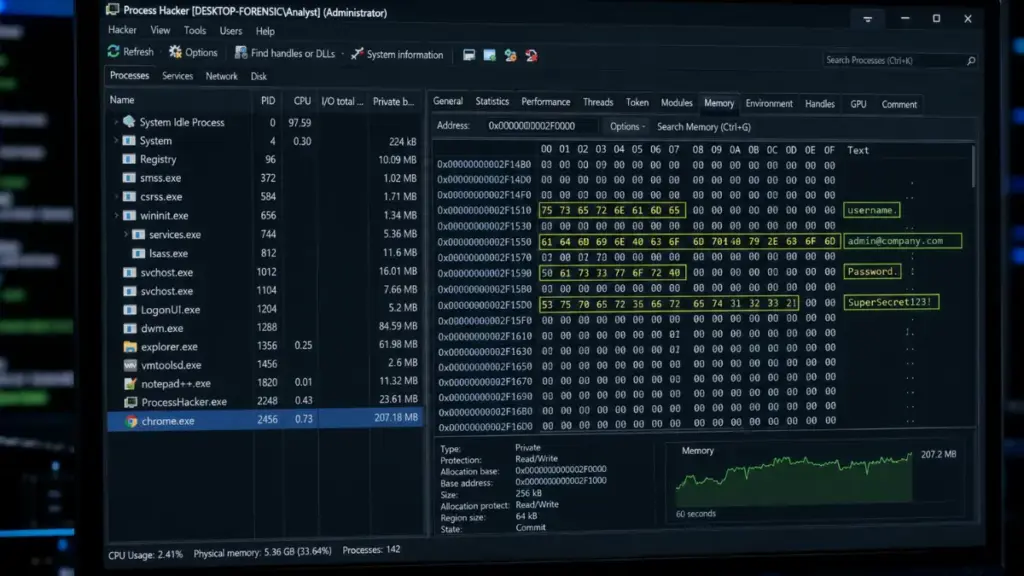
A major point of concern identified during independent security audits is the presence of persistent plain text strings left in memory long after a vault is locked. Ideally, clicking the lock button on a password manager should immediately overwrite all decrypted vault entries, derived cryptographic keys, and master password inputs with zeros before clearing process handles. However, empirical testing demonstrates that locking a vault often merely changes the user interface state while leaving decrypted data sitting inside host memory allocations.
This flaw occurs because closing a user interface window does not automatically force the underlying runtime environment to purge physical RAM pages. In many desktop environments, the application simply hides the vault UI components while retaining internal object instances to enable rapid re-authentication when the user re-enters their PIN or master passphrase.
Readmore: Passkey vs Password: Which Is More Secure?
Consequently, an attacker who gains brief access to a running machine—or executes a low-privilege background process—can trigger a process dump of the locked password manager and search the resulting binary file for known data structures. Because master passphrases and auto-filled site credentials exist as contiguous ASCII or UTF-16 strings, simple pattern-matching algorithms can easily extract these secrets from gigabytes of raw memory noise.
Memory Dump Exploits and Process Hollowing Attack Vectors
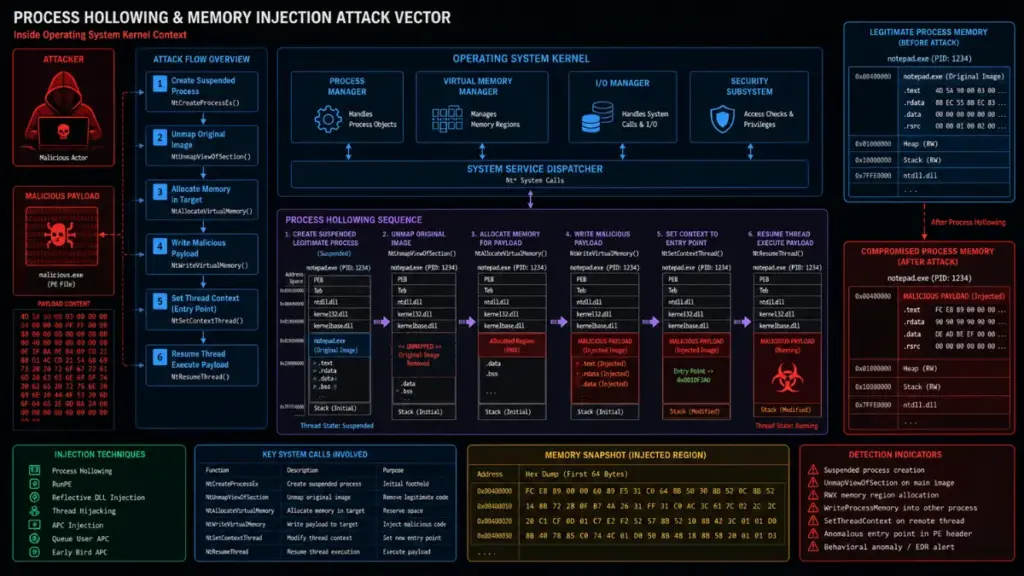
Beyond passive string retention, active exploitation techniques pose a severe threat to endpoint credential security. One widely documented method involves process memory dumping, where an unauthorized process queries the operating system API to inspect or duplicate the virtual memory space of a running password manager. On desktop platforms, standard administrative or user-level utilities can request process memory reads unless explicit kernel-level protections are actively enforced.
Another sophisticated vector relies on process hollowing and dynamic DLL injection. In this scenario, specialized infostealer malware targets the running executable of a password manager, hooks its internal API calls, and reads decrypted memory buffers directly as the application processes auto-fill requests.
- Process Scraping: Background malware continuously scans user-space RAM addresses for key patterns, token formats, and credential pairs.
- API Hooking: Malicious payloads intercept function calls between the user interface and the core cryptographic module to copy raw string inputs.
- LSASS and Process Dumping: Attackers utilize native OS diagnostics to write entire application memory spaces to disk for offline analysis.
Because these memory inspection techniques operate entirely within volatile host RAM, they leave minimal footprints on persistent storage disks, making traditional file-based detection mechanisms largely ineffective at stopping them.

How Malware Orchestrates Mass Credential Stuffing via Compromised Memory
The ultimate objective of harvesting credentials from an unlocked password manager is almost always financial exploitation, corporate espionage, or automated account takeover. When modern infostealer malware successfully extracts a master password or a batch of decrypted site credentials from RAM, it does not hold that data passively. Instead, the stolen credentials are bundled with system metadata, browser cookies, and hardware identifiers, then exfiltrated via encrypted channels to automated command-and-control infrastructure.
More Read

Once exfiltrated, these credential stashes are fed into automated credential stuffing frameworks. Because individuals frequently reuse passwords across secondary accounts—or rely on predictable variations of their primary master passphrase—compromising a single vault’s memory structures can compromise a user’s entire digital footprint across dozens of corporate and personal services.

From Memory Extraction to Automated Credential Stuffing Networks
Credential stuffing is a cyberattack methodology where automated scripts test large volumes of stolen username and password pairs against widespread login portals. When an attacker extracts raw login records from a compromised password manager session, the quality of the stolen data is exceptionally high. Unlike generic breach dumps containing outdated or hashed passwords, credentials scraped directly from active RAM represent current, fully validated accounts.
Modern cybercrime syndicates integrate scraped memory payloads directly into specialized credential stuffing software suites. These platforms automatically route authentication attempts through vast proxy networks to bypass IP rate-limiting and geographical fencing controls.
“A single memory leak in a desktop password manager provides attackers with highly accurate, pre-validated credentials, drastically increasing the success rate of automated credential stuffing operations.”
Luna
By leveraging fresh credentials harvested directly from volatile memory, automated attack bots can achieve login success rates exponentially higher than traditional brute-force tactics. This allows malicious actors to breach high-value targets, including cloud management consoles, financial institutions, and internal corporate repositories, within minutes of extracting data from a victim’s RAM.
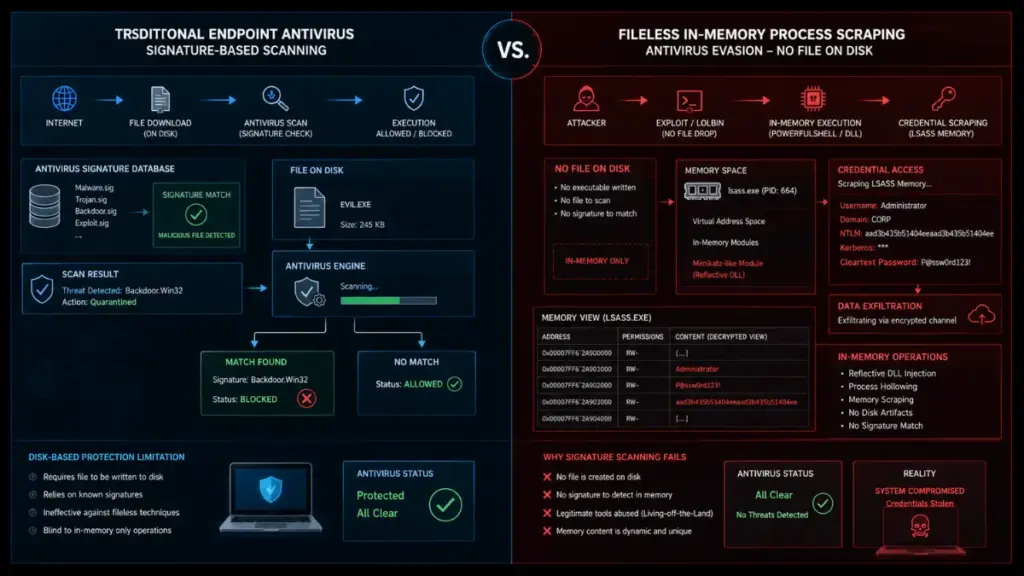
Why Standard Anti-Malware Fails Against In-Memory Password Manager Attacks
Traditional antivirus software relies heavily on signature-based scanning, analyzing files stored on persistent local drives against databases of known malicious code signatures. However, memory scraping attacks targeting a password manager frequently operate entirely in memory—a technique known as fileless malware execution. By running malicious scripts directly inside legitimate system processes or utilizing native administrative commands, attackers execute memory reads without dropping detectable binaries onto the hard drive.
Furthermore, user-mode security software often lacks the granular process protection necessary to block one user-space application from reading the virtual memory of another process running under the same user privileges. If malware executes under the same user account as an active password manager, operating system security policies typically permit the malware to inspect or dump the target process memory space without raising system alarms.
- Fileless malware avoids disk-based file write operations, leaving no static signature for basic endpoint protection tools to scan.
- Native administrative APIs permit processes running under identical user security contexts to inspect memory structures freely.
- Polymorphic code structures continuously alter memory footprints to evade heuristic detection algorithms.
This architectural limitation underscores why relying solely on traditional endpoint security tools is insufficient to safeguard volatile RAM contents from advanced memory-scraping threats.
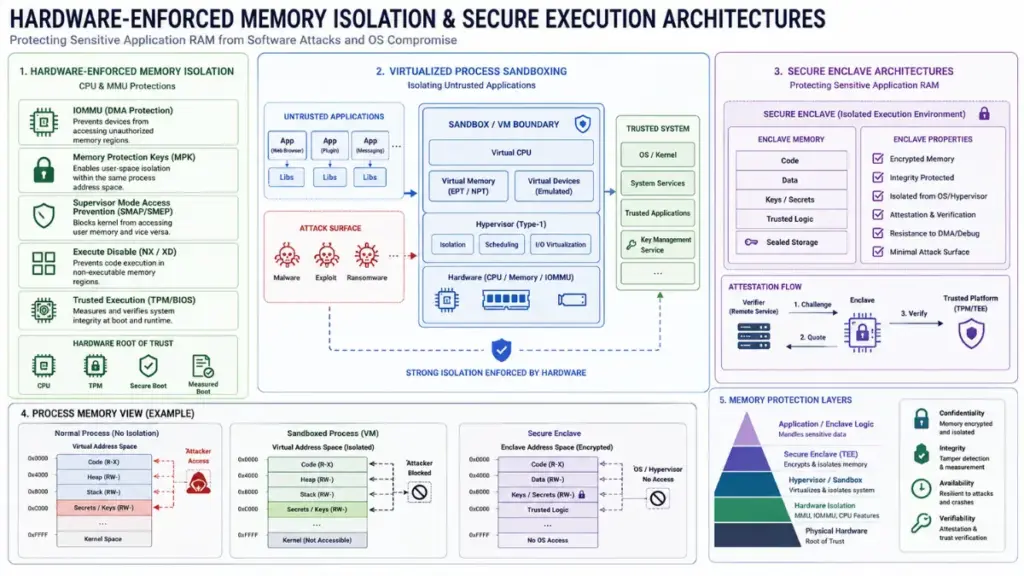
Essential Mitigations to Protect Your Password Manager Memory Footprint
Addressing volatile memory flaws requires a multi-layered defensive strategy combining rigorous software engineering practices, proactive user configurations, and hardware-enforced operating system security controls. While end users cannot rewrite an application’s underlying code, choosing software architectures built with memory safety in mind significantly reduces exposure risks. Modern secure software development standards mandate using memory-safe programming languages like Rust or Go, incorporating explicit SecureMemory allocation wrappers, and enforcing immediate byte-clearing routines upon vault lock events.
On the client side, users must actively configure their security software environment to minimize the operational window during which decrypted credentials remain inside system RAM. By reducing session timeouts, restricting clipboard retention, and enforcing strict OS-level memory integrity policies, organizations can harden their endpoints against process scraping attacks.
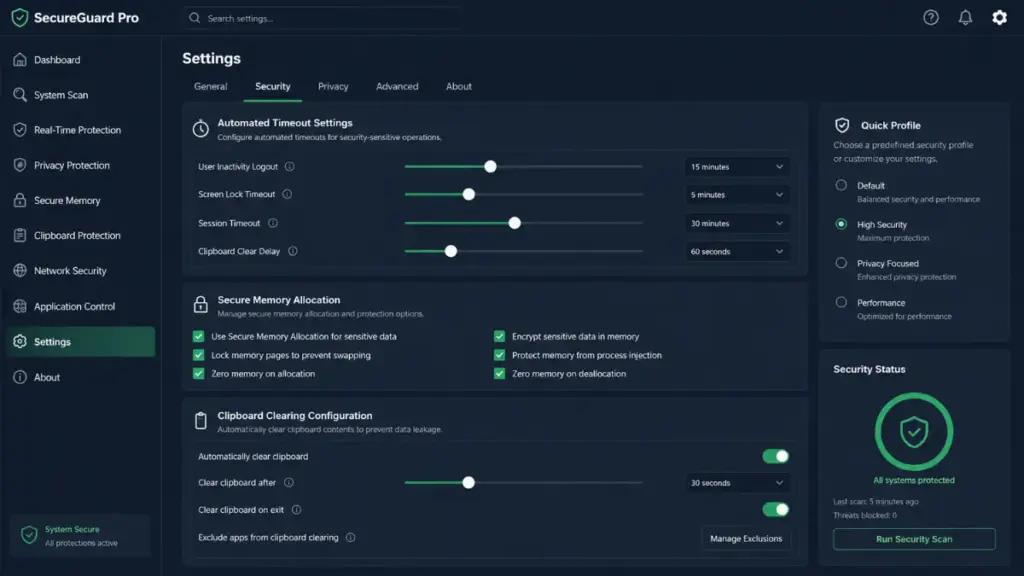
Best Practices for Clearing Active Memory in Password Manager Software
To mitigate residual memory risks, users must optimize application settings to restrict how long decrypted data persists inside volatile RAM. Leaving a password manager unlocked indefinitely throughout a workday creates an unnecessarily large window of vulnerability for background memory scraping processes. Configuring aggressive idle lock timeouts ensures that cryptographic keys are purged from active memory buffers as soon as user activity ceases.
Additionally, managing clipboard behavior is critical. When a user copies a password to paste into a web form, that plain text string enters the operating system clipboard buffer, which is often accessible to every running application.
- Set the application auto-lock timer to a short duration (e.g., 5 to 10 minutes of system inactivity).
- Enable automatic clipboard clearing functions set to purge copied credentials within 10 to 20 seconds.
- Disable clipboard history features within the host operating system to prevent string persistence.
- Completely terminate and exit the application process when leaving the workstation unattended.
By enforcing these configuration habits, users dramatically shrink the timeframe available for malicious processes to capture plain text secrets from host RAM buffers.
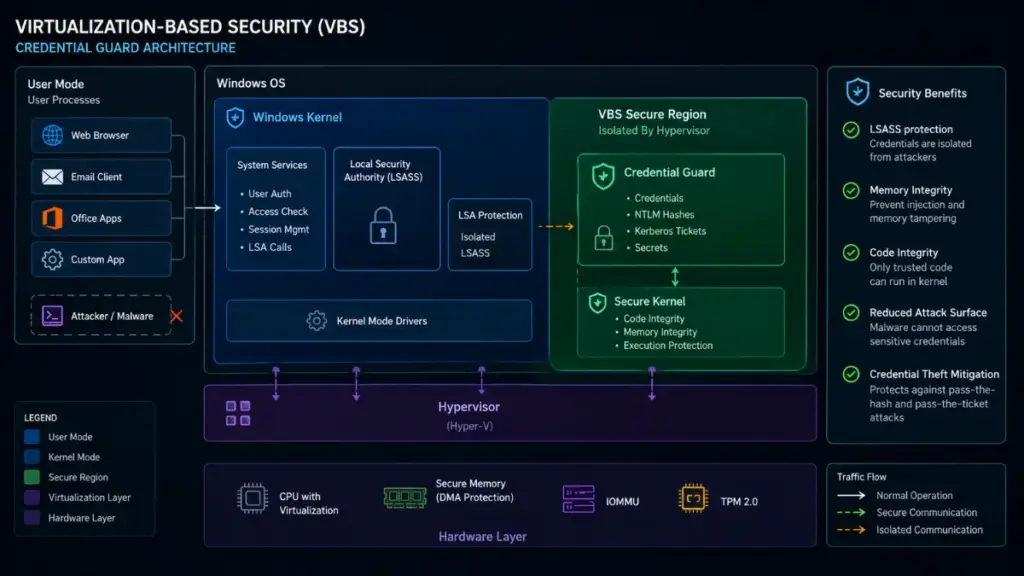
Advanced Operating System Protections for Secure Password Manager Storage
At the operating system level, advanced hardware-enforced security features provide critical boundaries that prevent unauthorized processes from reading sensitive memory space. Modern operating systems offer virtualization-based security (VBS) and memory integrity protections that isolate critical security processes inside hypervisor-protected enclaves.
Enabling these features ensures that even if user-mode malware executes on an endpoint, the host operating system blocks attempts to hook processes, inject dynamic link libraries, or execute direct memory dumps against protected software.
Readmore: Passkeys: 7 Dangerous Realities Big Tech Won’t Tell You Before You Switch
Furthermore, deployment of Endpoint Detection and Response (EDR) agents capable of monitoring API calls in real time allows security teams to detect and terminate unauthorized process memory inspection tools before they extract cryptographic material. Combining robust software choices with hardware-backed operating system security establishes a highly resilient defense against memory exploitation tactics.

Conclusion
While adopting a reputable password manager remains a non-negotiable security best practice, users and administrators must recognize that local memory handling represents a persistent attack surface. Zero-knowledge architecture provides exceptional protection against cloud breaches, but it cannot fully neutralize the risks posed by volatile memory leaks when a vault is active on a compromised endpoint. By understanding how plain text secrets linger in RAM, how malware leverages these remnants to execute widespread credential stuffing attacks, and how hardware-backed memory protections mitigate these vectors, organizations can build a defense-in-depth posture that keeps sensitive credentials truly secure.
PLEASE LEAVE A COMMENT BELOW TO GET FREE EXPERT CONSULTATION OR FOLLOW OUR WEBSITE THE COUCH INSIDER TO STAY UPDATED WITH THE LATEST MARKETING INSIGHTS.